
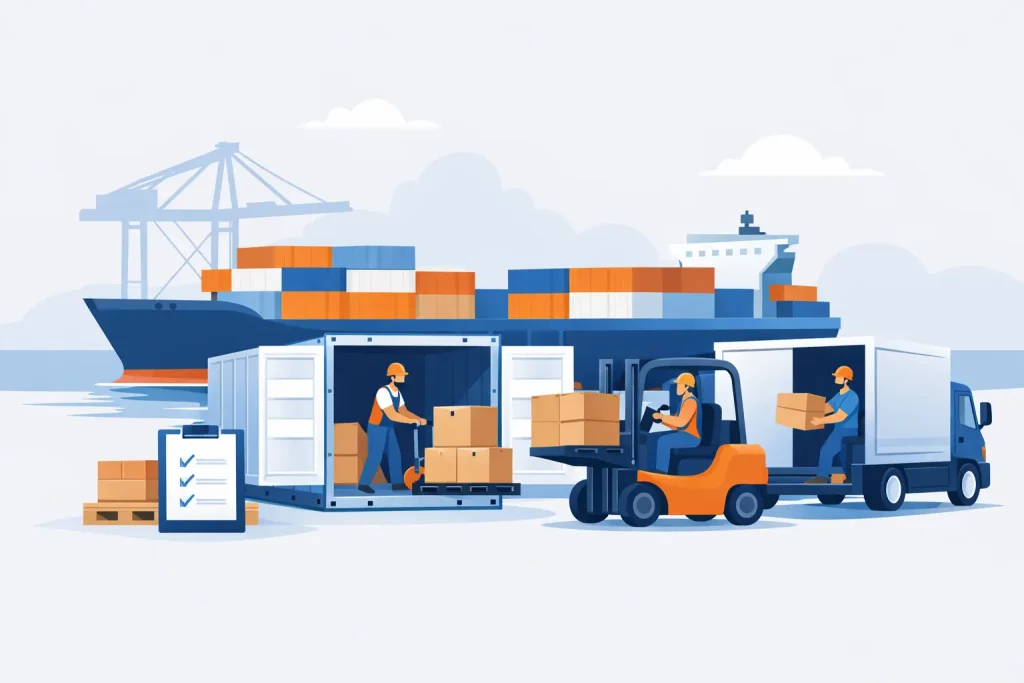
When a container lands, the pressure starts immediately. Every hour it sits unopened can affect storage costs, labour planning, inbound scheduling and, ultimately, your ability to fulfil orders on time. That is why container devanning services are not a minor warehouse task. They are a control point that can either protect your supply chain or expose it.
For importers, growing brands and operations teams managing tight timelines, devanning needs more than available floor space and a forklift. It needs process discipline, product awareness and a team that understands what is at stake when inventory arrives compressed into a container after weeks in transit. If stock is handled poorly at this stage, the damage is rarely limited to the receiving dock. It flows into inventory discrepancies, delayed putaway, picking errors, damaged units and strained customer delivery commitments.
What container devanning services actually cover
At a practical level, container devanning services involve unloading cargo from shipping containers and transitioning that stock into a controlled warehouse environment. In reality, the work is far more exacting than simply emptying a box.
A quality-first devanning operation includes careful unloading, carton or pallet inspection, count verification, segregation of damaged or non-conforming stock, and structured transfer into storage, cross-dock or fulfilment workflows. The objective is not just speed. It is accuracy at the point inventory changes hands.
That distinction matters. Containers often arrive with mixed SKUs, tightly packed cartons, awkward load patterns or goods shifted during transit. Some are floor-loaded to maximise cubic space. Others contain high-value, fragile or presentation-sensitive products that cannot tolerate rough handling. The right devanning team works with that complexity rather than treating every container the same.
Why this stage has such a big operational impact
Inbound mistakes are expensive because they multiply. If a carton is miscounted during unload, the issue may not appear until picking. If damage is missed at devanning, your team may discover it only after stock has been allocated to orders. If pallets are built incorrectly or labelling is inconsistent, putaway slows down and warehouse space is used inefficiently.
Done properly, devanning creates clean inventory visibility from day one. Your stock is received with control, exceptions are identified early and warehouse activity can continue without avoidable rework. For businesses that run lean stock levels or high order velocity, that level of precision is not optional.
There is also a cost element that is often overlooked. Demurrage, detention and port timing pressures can create unnecessary spend when unload capacity is not available at the right moment. A provider with structured inbound planning can reduce those delays and keep freight moving before costs escalate.
Container devanning services and stock integrity
Not all inventory can absorb handling errors. Premium consumer goods, healthcare-related products, retail-ready lines, promotional packs and fragile items all carry a higher consequence when received carelessly. Outer cartons may look intact while inner units have shifted, crushed or split during transport.
This is where a generic unload approach falls short. Good container devanning services are built around stock integrity, not just labour throughput. That means using the right equipment, unloading to suit product type, checking for visible transit issues and isolating exceptions before they contaminate good inventory.
For brand owners, this matters beyond warehouse efficiency. Your inventory arrives as a representation of your business. If products reach customers scuffed, incomplete or poorly presented because of rushed inbound handling, the problem is no longer operational. It becomes a brand problem.
Speed matters, but only when paired with control
There is a common assumption that the best devanning service is the fastest one. Speed does matter, particularly when containers are arriving into a busy inbound schedule or stock is needed urgently for replenishment. But speed without process control is where avoidable errors creep in.
A disciplined operation balances pace with verification. Counts need to be checked. Damaged cartons need to be noted. Mixed loads need to be sorted correctly. Pallets need to be stable, labelled and ready for the next movement. If any of that is skipped in the name of getting the container empty, the warehouse ends up paying for it later.
The better question is not how fast a provider can unload a container. It is how reliably they can unload it, account for it and move it into your next workflow without loss of accuracy.
When outsourcing devanning makes sense
Some businesses have the space and team to devan containers internally. For others, it creates more strain than value. If your warehouse is already busy with pick and pack, dispatch and replenishment, container arrivals can disrupt the entire floor. Labour gets pulled off priority work, receiving areas become congested and inventory may sit unprocessed longer than it should.
Outsourcing makes sense when inbound volume is inconsistent, when floor space is limited or when your products require a higher handling standard than a general warehouse setup can support. It also makes sense when devanning needs to feed directly into storage, kitting, cross-docking or distribution without delays between stages.
For growing brands in particular, outsourcing can be a cleaner way to scale. You gain access to trained labour, warehouse systems and planned inbound capacity without having to overbuild your own infrastructure around container peaks.
What to look for in a devanning partner
The right partner should be able to explain their process with clarity. Not in vague service language, but in operational terms. How are bookings managed? What happens when a container arrives floor-loaded? How are shortages, overages and damages recorded? How quickly can stock be receipted and made visible? How is urgent stock prioritised?
Those details reveal whether a provider is built for disciplined execution or simply offers devanning as an add-on service.
Responsiveness also matters. Container schedules change, vessels run late and urgent delivery requirements appear with little notice. A devanning partner should have enough agility to adjust while still maintaining process control. That combination is where boutique logistics providers often outperform larger volume-driven operators. The service is not generic. It is built around your operational reality.
You should also consider what happens after unload. If stock needs to move into warehousing, pick and pack, co-loading or store distribution, the handover between services should be tight. Fragmented handling creates risk. Integrated handling reduces it.
A better inbound model for growing businesses
As supply chains become more compressed, the inbound dock has become a decision point rather than a simple receiving function. Businesses are carrying tighter inventory positions, launching more frequently and managing higher customer expectations around availability and delivery timing. In that environment, container devanning services have a direct influence on downstream performance.
A precise inbound model does three things well. It gets containers unpacked without delay, protects the condition of stock while it is handled, and gives the business immediate confidence in what has actually arrived. That confidence supports better planning across warehousing, fulfilment and distribution.
For businesses with premium products or demanding retail standards, there is an additional advantage. You can maintain consistency in how your goods are treated from the moment they leave the container through to final dispatch. That level of control is difficult to achieve when devanning is rushed, improvised or treated as low-skill labour.
Durazon Logistics approaches devanning as part of a broader quality-first warehouse flow, with handling discipline and inventory control built around the needs of each client. That matters when your inbound process has to do more than move stock. It has to protect it, account for it and keep your operation moving.
The strongest logistics partnerships are usually built on small moments of execution done properly. A container opened on time, stock counted accurately, damaged units identified early, pallets staged correctly and inventory made visible without delay – that is the kind of operational reliability that keeps your business ahead. If your inbound flow is under pressure, devanning is a smart place to tighten control.