
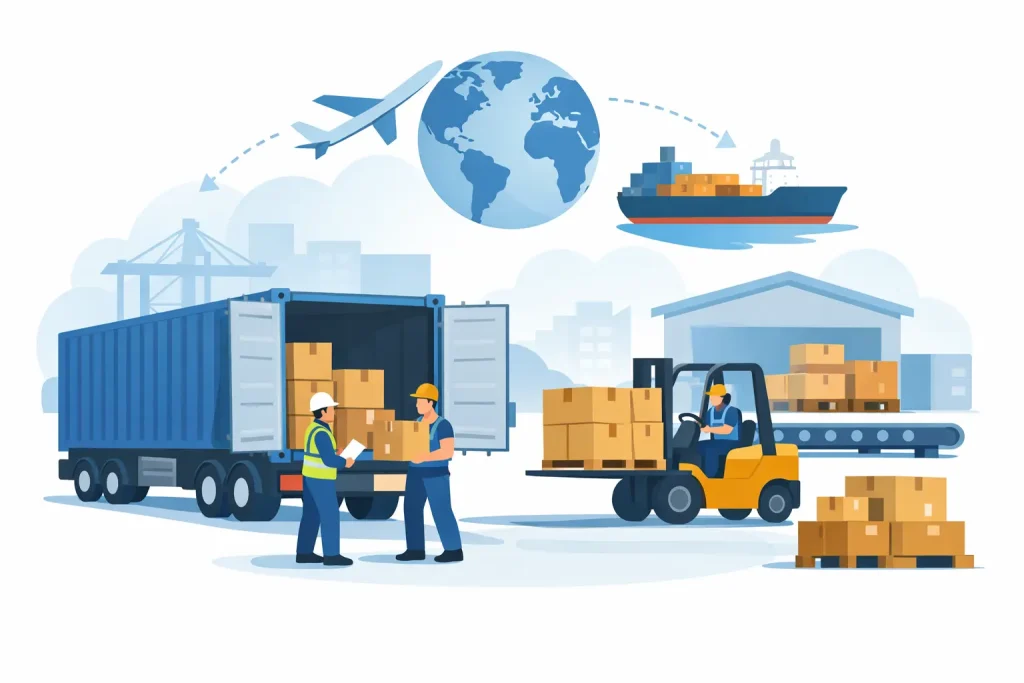
A container arriving at a warehouse is not simply a delivery. It is the point where overseas freight becomes accountable inventory – and where hidden damage, shortages or labelling errors can quickly become expensive customer-service problems. So, what is devanning in logistics? Devanning is the controlled process of unloading goods from a shipping container, checking their condition and quantity, and moving them into the next stage of the supply chain.
For importers and growing product brands, devanning is a critical handover. Done well, it protects stock integrity, creates an accurate inventory record and keeps fulfilment or distribution moving. Done poorly, it can introduce stock discrepancies that may not surface until an order is picked weeks later.
What is devanning in logistics?
Devanning, sometimes called container unloading or de-stuffing, is the removal of cargo from a sea freight container once it reaches a warehouse, distribution centre or approved unpack location. The work can involve floor-loaded cartons, pallets, crates, fragile items, mixed stock-keeping units and products with specific handling requirements.
The physical unloading is only one part of the task. A quality-first devanning operation also verifies the shipment against available documents, identifies visible damage, counts or scans stock, segregates product where required, and records exceptions before goods are received into the warehouse management system.
The exact scope depends on the shipment and the agreed service model. A business importing uniform pallets may need a straightforward unload and put-away. A brand receiving a mixed container of retail-ready goods may need palletising, carton labelling, quality checks, kitting or cross-docking immediately after unloading. The right process is built around the product, sales channels and speed required after arrival.
Why devanning matters to inventory control
International freight can look simple on a shipping schedule. In reality, containers can spend weeks in transit, pass through multiple handling points and arrive with limited visibility of what has happened inside. Devanning creates the first practical opportunity to inspect the shipment at destination and establish a reliable starting point for warehouse inventory.
For an operations manager, that means knowing whether the stock received matches the stock expected. For a brand owner, it means having confidence that products sent to retailers or direct customers meet the standard associated with the brand.
A disciplined devanning process helps control several common risks:
- Carton or product damage caused by load movement, moisture, crushing or poor packing at origin.
- Quantity variances between packing lists, purchase orders and physical stock.
- Mixed or incorrectly labelled cartons that can create picking errors later.
- Unsafe unloading caused by unstable loads, loose cargo or unsuitable equipment.
- Delays between container arrival and stock becoming available for sale or fulfilment.
These are not minor administrative details. A missing carton may affect a retail allocation. An unreported damaged pallet may result in poor-quality stock reaching a customer. A delayed receipting process can leave a business selling inventory that is not yet ready to dispatch.
The devanning process, from arrival to put-away
A strong process begins before the container reaches the warehouse. The logistics provider should have container details, expected arrival timing, packing documentation, product handling instructions and a clear plan for where stock will go after unloading. This preparation allows the team to allocate labour, equipment and space without creating congestion across inbound operations.
Container arrival and safety assessment
Once the container is positioned, the team checks its external condition, seal information and any visible signs of damage. Before unloading starts, doors are opened carefully. Cargo can shift in transit, particularly when containers are floor-loaded or have not been properly restrained.
The unloading area must be suitable for the task. That includes safe access, adequate lighting, the right handling equipment and clear separation between people, machinery and inbound stock. Clinical precision at this stage protects both people and product.
Unloading and product handling
Goods are removed in a sequence that maintains stability and allows the team to inspect cartons, pallets or crates as they come out. Floor-loaded containers are often unloaded carton by carton, while palletised freight may be removed with a forklift or other appropriate equipment.
Handling requirements should reflect the product. Fragile, premium or temperature-sensitive goods require a different approach from durable, high-volume commodities. Cartons may need to be placed on pallets, wrapped for stability or separated by stock-keeping unit before they can enter storage.
Counting, checking and exception reporting
During or immediately after unloading, the shipment is checked against the packing list, purchase order or advance shipping information. Depending on the agreed level of control, this may involve a carton count, pallet count, barcode scan or detailed unit-level verification.
Visible damage, shortages, overages and incorrect product should be recorded promptly. Photographs, notes and clear reporting are valuable because they give the importer a factual record for supplier discussions, insurance claims or freight investigations. Waiting until stock has been moved through the warehouse makes it harder to establish where an issue occurred.
Receipting and warehouse integration
Once checks are complete, accepted stock is receipted into the warehouse management system and assigned to a storage location, fulfilment area or outbound dispatch lane. This is where devanning connects directly with inventory visibility.
For some businesses, goods need to be available for orders on the same day. For others, stock may move into quality assurance, retail preparation or kitting before it can be released. The service should match the operating reality, rather than forcing every shipment through a generic inbound workflow.
Devanning versus cross-docking
Devanning and cross-docking are closely connected, but they are not the same service. Devanning is the unloading and receiving of goods from a container. Cross-docking is the transfer of goods from inbound freight to outbound transport with minimal or no storage time.
A container may be devanned into warehouse storage, with goods put away for later fulfilment. Alternatively, selected cartons or pallets can be devanned, checked and cross-docked directly to a retailer, distributor or another freight service. This can reduce storage handling and accelerate delivery, but it requires accurate documentation, confirmed outbound capacity and confidence in the incoming stock condition.
Cross-docking is most effective when demand is known and the shipment is well organised. If a container contains mixed products, unclear labelling or goods that need detailed quality checks, a slower receiving process may be the more reliable choice.
What affects devanning time and cost?
There is no single devanning rate or timeframe that suits every container. The size of the container matters, but cargo configuration usually matters more. A 40-foot container filled with uniform pallets can be handled far more efficiently than a smaller container packed tightly with thousands of mixed cartons.
Cost and timing are shaped by the loading method, product weight, carton condition, number of stock lines, required checks, palletising needs, special equipment, labour requirements and the time allowed for container return. Seasonal peaks can also affect warehouse capacity and transport coordination.
The lowest unloading price is not always the lowest operational cost. A provider that rushes the work, skips meaningful checks or delays system receipting may create downstream losses through inaccurate stock, rework and missed dispatch windows. The better question is whether the service gives your team a clean, timely and traceable handover into the warehouse.
Choosing a devanning partner
For brands outsourcing inbound logistics, devanning should be assessed as part of the broader warehouse operation. Ask how exceptions are recorded, when inventory becomes visible, what happens to damaged goods, how quickly updates are communicated and whether the provider can scale during peak arrivals.
It is also worth confirming how the team handles non-standard requirements. This may include retail labelling, product segregation, disposal of packaging, quarantine stock, expiry-date controls or urgent outbound orders. A logistics partner that understands your product and operating priorities can make decisions at the dock that prevent disruption further down the line.
At Durazon Logistics, devanning is treated as a controlled inbound operation, not a simple unloading task. The objective is to receive goods with care, capture accurate information and move stock into the right next step for the business.
A container is often the first physical touchpoint in a longer customer promise. Set clear receiving standards before it arrives, and your warehouse has a far better chance of delivering the accuracy, product care and responsiveness your customers expect.
Pingback: Distribution Services for Importers That Scale - durazonlogistics.co.nz