
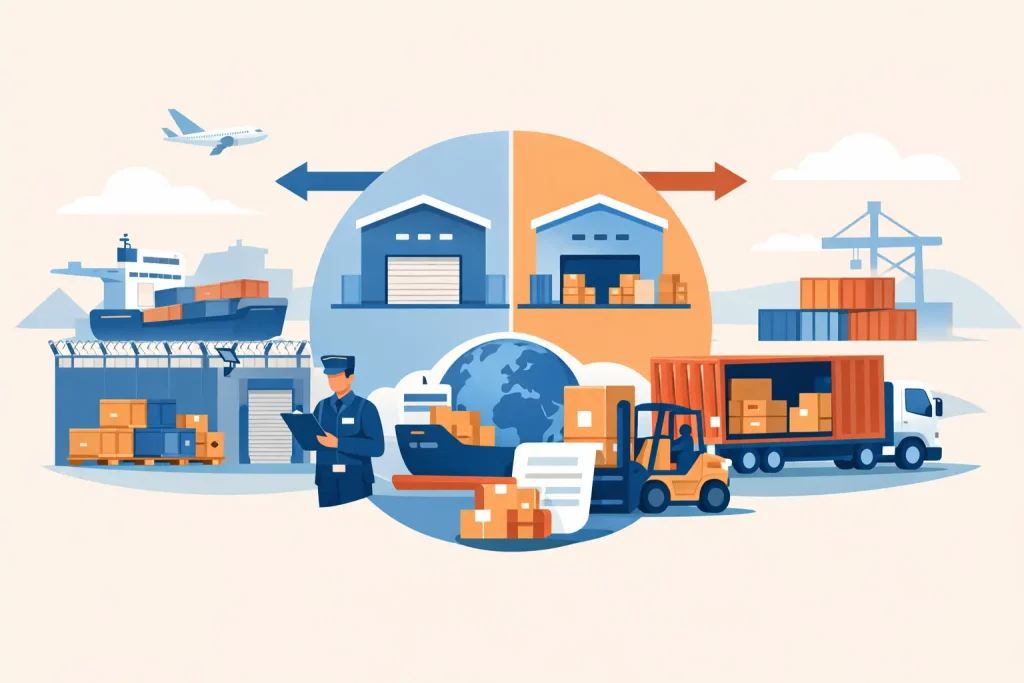
A container can arrive on schedule, clear the port and still create pressure on cash flow, storage capacity and stock control. This bonded warehousing comparison is designed for importers deciding whether holding goods under customs control is commercially worthwhile, or whether a standard warehouse provides the faster, simpler operating model their business needs.
The right answer is rarely based on freight volume alone. It depends on when stock will be sold, where it will be distributed, how reliably it can be forecast, and whether your warehouse partner can maintain disciplined control over every unit while it remains under customs supervision.
Bonded warehousing comparison: the operational difference
A bonded warehouse, more accurately described in Australia as a customs warehouse or a warehouse operating under a relevant Australian Border Force approval, stores imported goods that have not yet been entered for home consumption. Customs duty and import GST are generally managed at the point goods are entered into the Australian market, subject to the importer’s circumstances and applicable arrangements.
A standard warehouse stores goods that have already cleared customs and been released into local inventory. Once received, those goods can generally be picked, packed, kitted, transferred or distributed without the same customs-control requirements.
That difference changes the operating model. In a bonded environment, stock movements, quantities, access and documentation must align with the warehouse’s customs obligations. Goods cannot simply be shifted between locations, repacked or released because an operational team needs space. Every approved activity needs to be managed with precision.
For the right importer, this control creates useful flexibility. For the wrong operating profile, it can add administration without delivering a meaningful commercial advantage.
Duty timing versus total landed cost
The central benefit of bonded storage is not that duty disappears. It is that payment may be deferred until goods are entered for home consumption, exported, or dealt with under another approved customs process. This can protect working capital when a business imports stock ahead of a seasonal launch, holds a broad SKU range, or faces variable demand.
Consider an importer bringing in premium apparel several months before a retail campaign. Paying duty and import GST immediately can tie up funds well before stock generates revenue. Holding the goods in a customs-controlled warehouse can align duty payment more closely with release to the market.
However, deferral is not automatically a saving. Warehousing charges, handling requirements, compliance administration and slower release processes all carry a cost. If stock turns quickly and is dispatched within days of arrival, a standard warehouse may be more efficient. Your customs broker or adviser should confirm the duty and GST treatment relevant to your business, including whether a deferred GST arrangement applies.
Compliance changes how stock is handled
A standard warehouse is built for commercial flow: receive, put away, replenish, fulfil and despatch. A bonded operation must deliver that same discipline while preserving an auditable customs record.
Inventory accuracy is therefore not a service extra. It is fundamental. The warehouse must be able to identify which units are under customs control, where they are stored, what has been released, and what remains held. Physical segregation may be required depending on the goods and approval conditions, but digital segregation is equally critical. A shared spreadsheet is not sufficient when stock status affects customs liability.
The practical question is whether the provider has processes strong enough to prevent a simple warehouse error becoming a compliance issue. Misallocated stock, an unrecorded movement or an incorrect quantity can create avoidable investigations, delays and exposure for the importer.
When a bonded model makes commercial sense
Bonded storage tends to suit importers with longer inventory lead times, material duty exposure or a genuine need to control the timing of local release. It can be particularly useful for businesses importing high-value stock, building inventory for a peak trading period, distributing part of a shipment domestically and exporting another part, or managing uncertain sales channels.
It can also support a staged market-entry plan. Rather than clearing an entire shipment into local stock at once, an importer may release goods in planned batches as purchase orders, retail allocations or e-commerce demand justify it. This approach can improve cash discipline, especially when capital needs to remain available for product development, marketing or future purchase orders.
A standard warehouse is often the better option when goods are already cleared, stock moves rapidly, and the priority is immediate fulfilment flexibility. It is also the more straightforward model when frequent value-added activities are required, such as rework, labelling, kitting or promotional assembly. These activities may be possible within a customs-controlled arrangement, but they need to be assessed against the applicable permissions and process controls rather than assumed.
The comparison should therefore be based on your actual stock path, not a generic promise of duty savings. Map the journey from port arrival through storage, release, fulfilment, returns and any export activity. The value of a bonded solution becomes clear when it improves that end-to-end flow without creating friction elsewhere.
What to assess in a bonded warehousing provider
A warehouse licence alone is not a guarantee of quality execution. The provider’s operating discipline matters because your inventory, customs position and customer experience are connected.
Start with inventory visibility. Your team should be able to see stock status clearly: what is under customs control, what has been released, what is allocated to orders and what is available to sell. Real-time or near-real-time visibility helps prevent sales teams from committing stock that cannot yet be despatched.
Next, examine release controls. Ask who can authorise a release, how the instruction is recorded, how the warehouse checks quantities, and what happens when an order changes after cut-off. A quality-first provider will have clear escalation paths rather than relying on informal messages and manual workarounds.
You should also understand the physical handling model. Premium inventory deserves more than available floor space. Confirm how goods are receipted, inspected for visible damage, stored, cycle-counted and protected from mixing with other clients’ stock. Where kitting or labelling is required, establish exactly when the work can occur and how the process will be documented.
Finally, test the provider’s responsiveness before a problem occurs. Import operations rarely follow a perfect timetable. Containers can arrive early, documentation can be delayed and retail demand can shift overnight. A capable logistics partner responds quickly while maintaining control. Speed without process creates risk; process without responsiveness creates missed opportunities.
Questions that reveal operational maturity
When comparing providers, ask for practical answers rather than broad assurances. Four areas are especially revealing:
- How are customs-controlled and released goods identified within the warehouse management system and on the warehouse floor?
- What reconciliation process is used, how often is it completed, and who investigates discrepancies?
- Can the provider support staged releases, cross-docking, pick and pack, or co-ordinated distribution once goods are cleared?
- What is the escalation process for damaged cartons, quantity variances, late release instructions or urgent customer orders?
The answers should describe ownership, systems and exception handling. If a provider cannot explain how an issue is controlled, it is difficult to trust how it will be resolved under pressure.
Build the decision around the whole supply chain
A bonded warehouse should not sit apart from your wider fulfilment strategy. It needs to connect cleanly with inbound transport, devanning, quarantine requirements where relevant, customs brokerage, inventory reporting and final distribution. The hand-offs are where stock visibility is most often lost.
For growing brands, the strongest model is often a staged one. Imported goods are received under a controlled process, stock is released in line with commercial demand, then fulfilment and distribution are managed through the same accountable operational team. This reduces duplicated handling and gives the business a clearer view of available inventory and upcoming obligations.
It is also worth planning for scale. A bonded arrangement that works for one container a month may require different systems, space allocation and reporting when import volumes increase. Choose a provider that can adapt the operating model without reducing accuracy or treating your stock like a commodity.
The best bonded warehousing decision is the one that gives your business control at the point it matters most: over cash, inventory and customer commitments. Before committing, model your release pattern, test the provider’s exception processes and make sure every movement of stock is built around your business rather than forced into a generic warehouse workflow.