
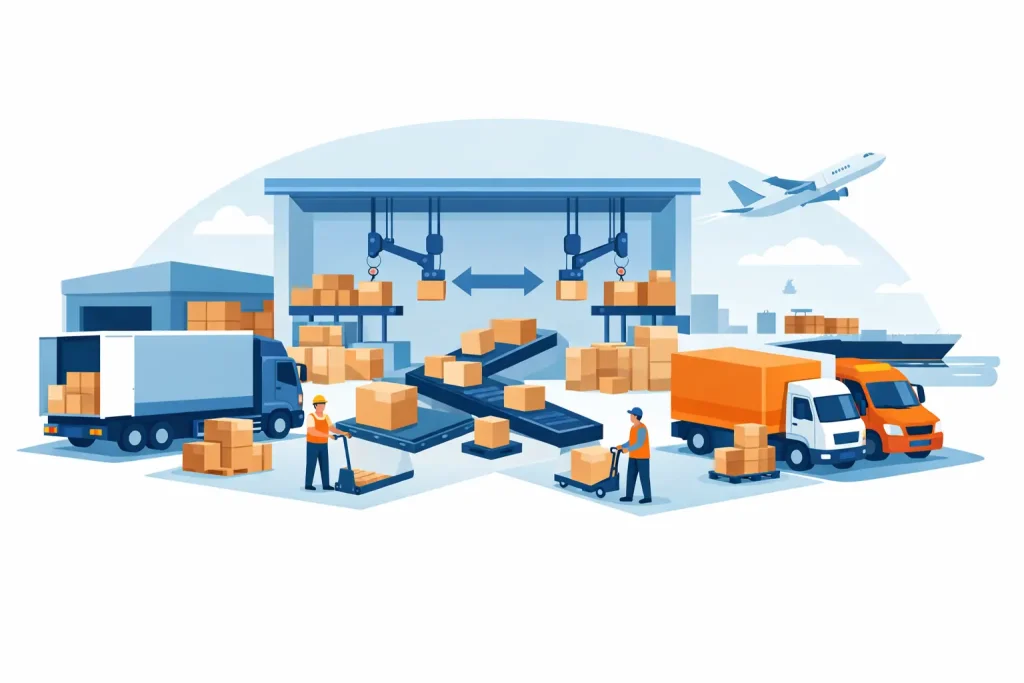
When freight lands at the wrong place for too long, it starts creating cost. Pallets sit, labour gets duplicated, inventory visibility slips, and delivery timelines stretch. That is usually the point where businesses ask, how does cross docking work, and whether it can remove unnecessary handling from their supply chain.
Cross docking is a transfer model where inbound goods are received, sorted, and moved directly to outbound transport with little or no storage in between. Instead of holding stock in a warehouse for days or weeks, the operation is designed to keep product moving. For businesses with time-sensitive freight, retailer delivery windows, imported containers, or high-throughput distribution needs, that can make a measurable difference.
How does cross docking work day to day?
At a practical level, cross docking works by compressing the time between receipt and dispatch. Freight arrives at the facility, is checked against booking and manifest data, unloaded, staged briefly in a designated dock area, then allocated to the next outbound vehicle or route. The goal is control without delay.
That sounds simple, but the real value sits in the planning. A disciplined cross dock operation relies on accurate inbound information, clear SKU identification, pre-allocated outbound orders, and tight coordination across carriers, warehouse staff, and delivery schedules. If any of those pieces are weak, speed quickly turns into confusion.
In a quality-first environment, inbound freight is not just pushed through the building. It is verified, counted, scanned where required, and assessed for any visible damage or discrepancy. Once confirmed, product is sorted by destination, customer order, route, or store allocation. From there, it is loaded onto the correct outbound vehicle, often within the same shift and sometimes within hours of arrival.
For some businesses, this process applies to full pallets moving intact from one vehicle to another. For others, it involves breaking down mixed freight, reconfiguring it, and rebuilding consignments for final distribution. The model depends on freight profile, order complexity, and delivery commitments.
The core stages in a cross dock operation
Cross docking is best understood as a series of controlled handovers rather than a storage process. The first stage is pre-arrival planning. Inbound vehicles need booked time slots, product data needs to be available, and outbound demand needs to be known early enough to allocate stock correctly.
The second stage is receival. Goods are unloaded and checked for quantity, condition, labelling, and alignment with paperwork or system data. This step matters. If stock enters the dock without validation, errors get transferred downstream and become harder to correct once outbound freight is already moving.
The third stage is sortation. Freight is directed into lanes, staging zones, or destination groups based on where it needs to go next. In some operations, that may be as straightforward as moving a pallet to a marked outbound bay. In others, especially where multiple customers or retail stores are involved, sortation can be more detailed and labour-sensitive.
The final stage is dispatch. Freight is loaded onto outbound vehicles in delivery sequence or according to route plan, then released for transport. The fastest cross dock sites do this with very little dwell time, but speed only works if stock traceability is maintained throughout.
Where cross docking fits best
Cross docking is not a universal answer, but it is highly effective in the right operating model. It tends to work well where freight already has a known next destination before arrival, where order volumes are predictable enough to plan transfers, and where reducing storage time creates a clear commercial benefit.
Importers often use cross docking after devanning containers, particularly when stock needs to be distributed across multiple customers, stores, or regional delivery points. Rather than placing everything into storage and picking it later, product can be allocated immediately and moved on. That reduces double handling and keeps imported freight from congesting warehouse space.
Retail supply chains also benefit when delivery windows are tight. If stores need replenishment by a certain day or hour, a cross dock can act as a controlled transfer point that consolidates inbound product and pushes it out quickly. The same applies to promotional stock, seasonal lines, and fast-moving SKUs where holding inventory adds little value.
For growing brands, cross docking can be useful during volume spikes. If inbound freight surges during peak periods, using a cross dock model for selected products can relieve pressure on primary storage locations and maintain dispatch flow without compromising control.
When cross docking is not the right fit
This is where the trade-off matters. Cross docking works best when inventory is ready to move. If stock needs quarantine checks, relabelling, assembly, quality inspection, or flexible order allocation after receipt, storage-based warehousing may be the better model.
It can also be less effective when inbound schedules are inconsistent or outbound demand is unclear. If trucks arrive late, manifests are inaccurate, or customer orders are changing at short notice, a cross dock can become a holding area in disguise. At that point, the operation absorbs the pressure of warehousing without the physical setup or timing tolerance that warehousing provides.
Product type matters too. Fragile, high-value, temperature-sensitive, or tightly regulated goods may need more handling discipline than a basic transfer environment can support. That does not rule out cross docking, but it raises the standard required from the operator. In those cases, process control is not optional.
Why businesses use cross docking
The main advantage is speed. Goods move through the network faster because they are not sitting in storage waiting for the next touchpoint. That can shorten lead times, improve delivery responsiveness, and support better service performance to retail, wholesale, or end customers.
There is also a cost benefit when the model is matched properly to the freight task. Fewer storage days, less putaway, and reduced picking activity can lower handling costs. It can also free warehouse capacity for inventory that genuinely needs to be stored.
Another major benefit is stock flow visibility. In a well-run cross dock, every movement is planned and tracked. You know what arrived, what was sorted, what was dispatched, and where exceptions occurred. For businesses managing premium inventory or strict customer commitments, that visibility supports stronger decision-making and fewer surprises.
Cross docking can also improve freight consolidation. Product from multiple suppliers can be combined into a single outbound delivery, or inbound loads can be separated into cleaner distribution streams. That helps simplify downstream transport and reduce avoidable inefficiencies.
What makes a cross dock operation work well
The difference between a productive cross dock and a chaotic one is process discipline. Timing matters, but accuracy matters just as much. The facility needs clear dock allocation, reliable scanning or inventory control practices, experienced staff, and tight communication between inbound and outbound transport.
Physical layout also plays a part. Goods should move through the site in a logical flow, with minimal backtracking and clear staging zones. If freight needs to be repeatedly shifted to make room for new arrivals, the operation loses both time and control.
Technology supports the process, but it does not replace execution. Real-time inventory visibility, booking systems, and shipment status updates are valuable because they allow the team to act early when there is a mismatch between plan and reality. Late trucks, short receipts, and damaged stock are manageable if identified quickly.
Most importantly, cross docking works best when it is built around the client’s trading pattern. A generic setup rarely delivers the best result. The handling profile for imported consumer goods is different from the profile for retail replenishment, wholesale distribution, or project freight. Precision comes from designing the process around the stock, the customer, and the delivery outcome.
How does cross docking work as part of a broader logistics model?
For many businesses, cross docking is not a standalone service. It is one part of a broader logistics structure that may also include devanning, short-term warehousing, pick and pack, co-loading, or final-mile distribution. Used this way, it creates flexibility.
A business might route fast-moving lines through a cross dock while storing reserve stock in warehouse locations. It might deconsolidate imported freight, cross dock urgent orders, and hold the rest for staged release. It might use cross docking for retailer compliance deliveries while managing ecommerce fulfilment separately. The strongest logistics models are not built around one method alone. They use the right method for each stock flow.
That is where a hands-on logistics partner adds value. At Durazon Logistics, cross docking is treated as a controlled operational function, not just a fast unload and reload. For brands that need accuracy, responsiveness, and careful stock handling, that distinction matters.
Cross docking works when movement is planned, handling is precise, and every transfer serves a clear purpose. If your freight is spending too long in places it does not need to be, it may be time to look at how much of that journey can be simplified.