
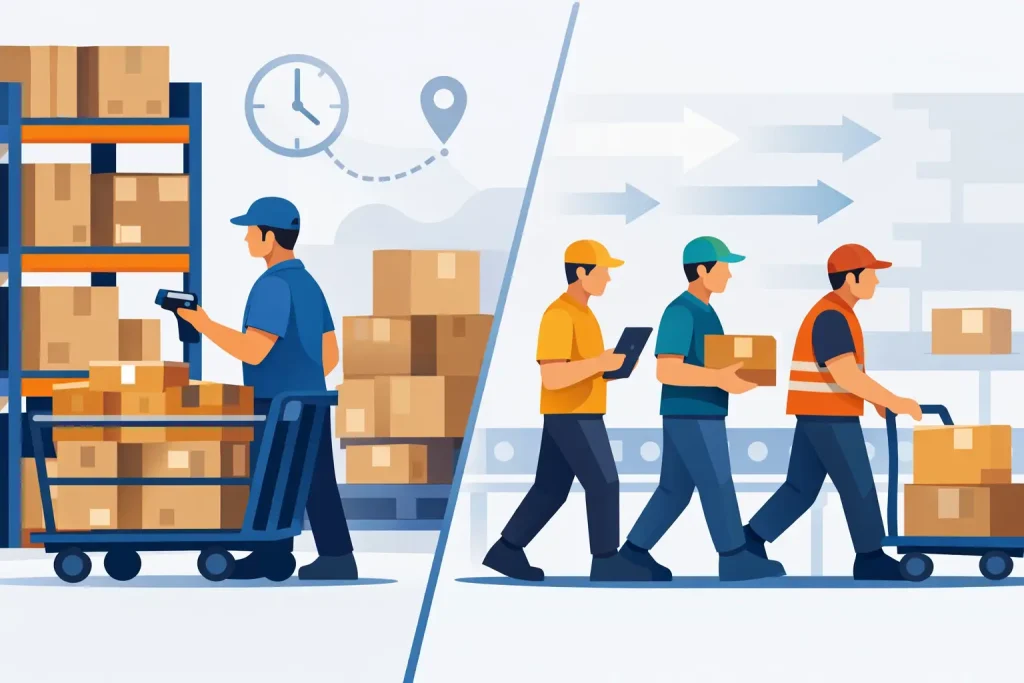
When order volumes rise, picking method becomes a service decision, not simply a warehouse preference. The choice between batch versus wave picking affects how quickly orders move, how accurately they are fulfilled, how labour is deployed and how confidently your business can promise delivery. For brands with valuable stock and high customer expectations, the right method protects more than productivity. It protects the customer experience.
Neither approach is automatically superior. The right fit depends on order shape, product range, dispatch commitments, warehouse layout and the level of control required across the day.
What is batch picking?
Batch picking groups multiple customer orders that contain the same or similar SKUs. Instead of a picker travelling to the same storage location for each individual order, they collect the total quantity needed for several orders in one visit. The picked stock is then sorted into individual orders at a consolidation or packing station.
Consider a skincare brand with 30 orders containing its most popular cleanser. With batch picking, a team member can travel to that pick face once, collect the required total quantity, then move it to packing for allocation. This reduces repeated travel, which is often the largest source of wasted time in a warehouse.
Batch picking works best where there is product overlap between orders. It is particularly effective for businesses with a concentrated SKU range, predictable demand, high volumes of small orders or a fast-moving product catalogue.
Where batch picking delivers value
The main advantage is travel efficiency. Less walking means more orders can be picked with the same labour resource, particularly when order lines are simple and stock locations are well organised. It can also make it easier to replenish high-volume pick faces before a major fulfilment run.
However, batch picking introduces a critical control point: sorting. Once items have been collected in bulk, every unit must be accurately assigned to the right customer order. If the sort process is poorly designed, the labour savings gained during picking can be lost through rework, packing delays or mis-picks.
For premium products, traceable stock and presentation-sensitive fulfilment, batching needs disciplined scan verification, clearly separated totes or bins, and a packing process that confirms each order before it leaves the facility. Speed without order integrity is not an operational win.
What is wave picking?
Wave picking releases groups of orders to the warehouse at planned times, or waves. Each wave is built around a rule that supports the wider operation. That rule may be a carrier collection time, delivery zone, order priority, product type, packing requirement, customer service level or available labour.
A warehouse might release a morning wave for same-day metro orders, a midday wave for standard parcel deliveries, and an afternoon wave for regional consignments. Pickers complete the work required for that dispatch window, allowing packing, carrier handover and inventory updates to follow a controlled rhythm.
Wave picking is less about combining identical items and more about synchronising fulfilment activity. A wave can use single-order picking, zone picking, batch picking or a combination of these methods. This is an important distinction: batch picking is a way to collect stock, while wave picking is a way to plan and release work.
Where wave picking delivers value
Wave picking gives operations teams greater control over the day. It aligns warehouse activity with carrier cut-offs, labour shifts and service commitments, rather than allowing orders to enter the floor in an uncontrolled stream.
This structure is valuable for brands managing multiple delivery services, retail replenishment alongside direct-to-consumer orders, or products that require specific packing, kitting or handling checks. It makes priorities visible. A rush order, a wholesale dispatch and a standard e-commerce parcel do not need to compete for attention in the same queue.
The trade-off is that waves require sound planning. If wave times are too rigid, urgent orders may wait longer than they should. If waves are released too frequently, the team can lose the focus and labour control that the method is designed to create. The schedule must reflect real order patterns, not an idealised warehouse plan.
Batch versus wave picking: the operational difference
The practical difference in batch versus wave picking comes down to the question each method answers. Batch picking asks, “How can we reduce travel while collecting these orders?” Wave picking asks, “When should this work be released so every dispatch is completed on time?”
Batch picking is usually strongest when many orders share common items. Wave picking is usually strongest when timing, prioritisation and coordination matter across multiple order types. In a mature fulfilment operation, the methods often work together.
For example, a wave may be created for all orders due to leave on a 2 pm carrier collection. Within that wave, fast-moving SKUs can be batch picked, while bulky, fragile or personalised orders are picked individually. This model preserves speed where it is safe to do so, while maintaining the control required for exceptions.
The decision should not be driven by headline pick rates alone. A method that produces more picks per hour but increases short shipments, incorrect variants or missed dispatch cut-offs creates costs that are harder to see and far more damaging to a brand.
How to choose the right picking method
Start with the order data. Look at the number of order lines, SKU repetition, daily order peaks, service-level commitments and the percentage of orders requiring special handling. A business shipping five-item orders with little SKU overlap has different needs from one shipping hundreds of near-identical single-item parcels.
You should also assess your physical operation. Batch picking relies on efficient consolidation space and clear order segregation. Wave picking relies on accurate order release, live inventory visibility and enough capacity at packing stations when a wave is completed. Neither method performs well if stock locations are inconsistent or replenishment is reactive.
The following conditions generally point to each approach:
- Batch picking suits repeated SKUs, high volumes of similar small orders and layouts where picker travel is a clear constraint.
- Wave picking suits defined carrier cut-offs, several order priorities, complex dispatch schedules and operations where labour needs to be balanced across the day.
- A combined approach suits growing brands with varied channels, changing order profiles and a need to scale without compromising fulfilment accuracy.
- Individual order picking may still be the right choice for high-value, highly customised, bulky or fragile orders where careful verification matters more than travel efficiency.
A controlled trial is more useful than a theoretical decision. Measure pick time, pack time, orders dispatched before cut-off, error rate, rework, stock adjustments and labour hours for each approach. Review the results by order type, not just as one blended average. A method may be highly effective for e-commerce parcels and unsuitable for wholesale cartons.
Accuracy must sit ahead of speed
Picking efficiency should never remove accountability. Every additional hand-off creates another point where stock can be misplaced, mixed or incorrectly allocated. This is especially relevant for businesses handling premium consumer goods, regulated products, promotional kits or inventory with multiple variants.
A quality-first operation builds control into the process: barcode scans at pick and pack, location discipline, exception handling, clear tote identification and final order verification. It also gives the team authority to stop and investigate discrepancies before they become customer complaints.
Real-time inventory visibility supports both methods. With accurate stock data, a warehouse can release waves with confidence, avoid picking unavailable units and identify replenishment requirements before a picker reaches an empty location. Without it, even an efficient workflow becomes a series of manual workarounds.
Design the process around your actual promise
There is no value in copying a high-volume fulfilment model if it conflicts with the promise your brand makes to customers. A luxury product may need a more deliberate pack check. A fast-growing online retailer may need several order releases each day. An importer supplying retail partners may need waves built around appointment windows and pallet preparation.
Durazon Logistics treats picking as part of the broader fulfilment system, connecting inventory control, handling standards, packing requirements and distribution timing. The objective is not to force every client into one workflow. It is to build a disciplined process around the way their business sells, scales and serves its customers.
Choose the method that gives your team enough pace to meet demand and enough control to stand behind every order. That balance is where dependable fulfilment is built.