
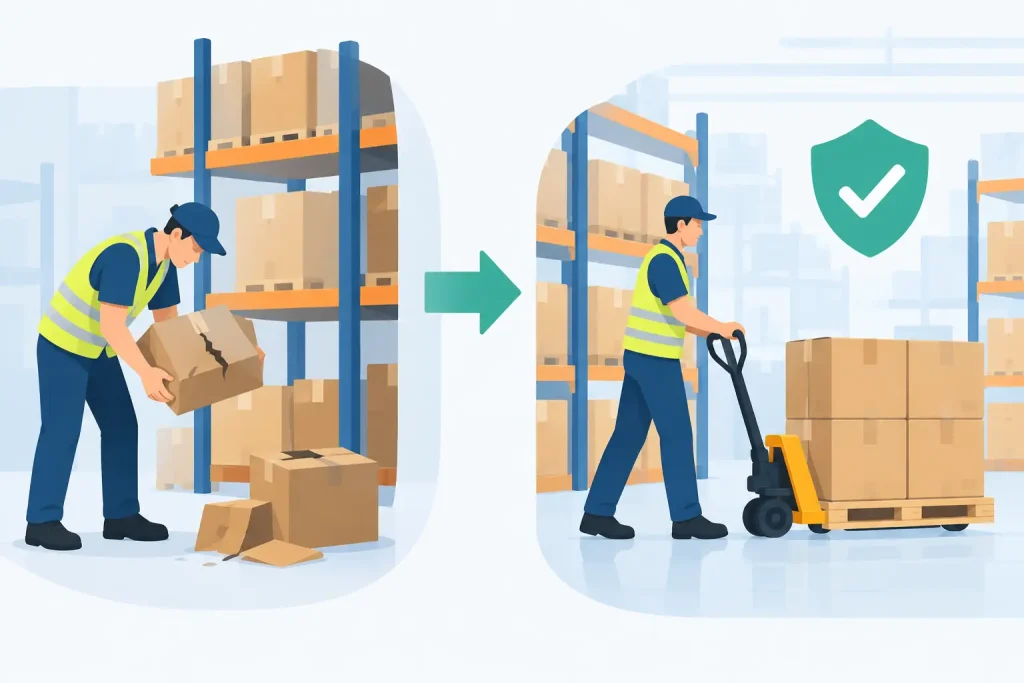
A damage reduction example is most useful when it follows stock through the actual points where control can fail: receipt, putaway, storage, picking, packing and dispatch. For brands with premium, fragile or presentation-sensitive products, damage is not simply a warehouse cost. It creates replacement freight, customer service workload, lost sales and a direct risk to brand trust.
The most effective approach is not to ask a team to “be more careful”. It is to build a handling system where expectations are visible, exceptions are captured immediately and every movement has an accountable standard. That is how damage reduction becomes measurable operational performance rather than a broad intention.
A damage reduction example in practice
Consider an importer distributing 12,000 units of boxed glassware each month. The product arrives in mixed cartons, is stored on pallets, picked as single units and sent to retail and direct-to-consumer customers. Over a three-month period, the business records 180 damaged units across inbound receiving, warehouse handling and outbound delivery preparation.
That represents a damage rate of 0.5 per cent. On paper, this may appear manageable. In practice, each damaged unit carries more than its landed cost. The business must investigate the issue, adjust inventory, arrange a credit or replacement, absorb additional freight and potentially manage a disappointed customer. For a premium product, even one damaged order can undermine the experience the brand has worked hard to create.
An operational review finds that the damage is not coming from one major event. It is being created by several small failures. Cartons are occasionally received with crushed corners but accepted without a condition record. Some pallets are stacked above the recommended height. Pickers are removing individual units from outer cartons that no longer provide adequate internal support. Dispatch cartons are selected by availability rather than product fit.
The solution is a controlled set of changes, applied at every handling point.
1. Tighten inbound checks
The receiving team photographs any pallet with visible external damage before it is unloaded or signed for. Carton condition, quantity discrepancies and water exposure are recorded against the inbound shipment. Where product damage is suspected, the stock is quarantined and counted separately before it becomes available inventory.
This protects the brand in two ways. It provides a clear record of stock condition on arrival, and it prevents damaged units from being mixed into saleable stock. It also gives the importer reliable evidence when a carrier or supplier claim is required.
2. Set storage rules around the product
The warehouse creates a defined storage profile for glassware: maximum pallet height, no overhang, no double stacking, a nominated racking location and a clear separation between reserve stock and active pick faces. Damaged outer cartons are re-cartoned before putaway where the product remains saleable.
These controls may marginally increase receiving time and use more warehouse materials. That trade-off is justified when the cost of recurring breakage exceeds the cost of careful handling. Product characteristics should determine the process, not a generic warehouse rule applied to every SKU.
3. Improve pick and pack discipline
Pickers are instructed to lift cartons from stable surfaces rather than drag them across pallet edges or shelving. Part-carton picks are transferred into approved internal totes, reducing the risk of loose units moving through the facility without protection.
At the packing bench, the team uses a packing matrix based on the order configuration. A single unit receives a fitted carton and protective void fill. Multiple units are separated internally and packed in a carton rated for the combined weight. The packer performs a final visual check of the product box before sealing the shipment.
The objective is not to use the maximum amount of packaging. Excess void fill, oversized cartons and inconsistent materials can create their own problems, including movement in transit and higher freight costs. The right packing specification is product-specific, repeatable and reviewed when order patterns change.
4. Measure the cause, not just the total
Each damage incident is coded by stage: inbound, putaway, storage, picking, packing or dispatch. The team also records the SKU, operator area, carton type and whether the issue was identified before or after the order left the facility.
Within eight weeks, the importer’s damage rate falls from 0.5 per cent to 0.16 per cent. More importantly, the data shows that outbound breakage has dropped sharply while inbound damage remains relatively consistent. This tells the business that its warehouse controls are working, while supplier packaging or linehaul handling still requires attention.
That distinction matters. A single total damage figure can hide the real source of loss. Good reporting directs effort to the point where a process change will have the greatest effect.
The controls that make reduction repeatable
Damage reduction holds when it is embedded in daily execution. A warehouse team needs clear product handling instructions that are easy to access on the floor, especially for high-value, fragile, temperature-sensitive or presentation-critical stock. Instructions should state what good handling looks like, what cannot occur and what to do when an exception is found.
Physical controls are equally important. Suitable pallet configuration, racking protection, designated quarantine locations, correctly sized cartons and clean work areas all reduce opportunities for accidental loss. A congested pick face or improvised packing station will eventually produce inconsistent outcomes, regardless of how capable the team is.
Training should be specific rather than general. Telling a new team member that an item is fragile is less useful than showing them the correct lifting method, storage orientation, pack-out requirement and escalation process. Refresher training is particularly valuable after a new product launch, seasonal labour increase or packaging change.
Quality checks also need to be proportionate. Inspecting every low-risk unit may add cost without improving performance. For a high-value cosmetic range, a limited-edition product or a fragile import consignment, more frequent checks may be essential. The control level should reflect product risk, order volume and the consequence of failure.
Where brands often lose control
Many damage programmes fail because the business only investigates visible customer returns. By that point, the stock has already travelled through several handling stages and the evidence is incomplete. Damage should be captured when it is first seen, including concealed damage discovered during picking or packing.
Another common issue is treating inventory adjustments as a finance task rather than an operational signal. A write-off with no reason code does not explain whether the problem sits with a supplier, carrier, storage layout, packaging specification or warehouse practice. Accurate stock adjustments are part of quality control.
Communication across partners is also critical. If a brand changes its product packaging, carton dimensions or pallet configuration, the warehouse must know before the new stock arrives. If a 3PL identifies repeated inbound crush damage, the supplier and freight provider need clear evidence promptly. Delay turns a fixable pattern into routine loss.
At Durazon Logistics, this is the standard expected of a quality-first operation: stock is handled with defined controls, exceptions are visible and decisions are made from reliable operational data. A logistics partner should act as an extension of the brand, not a point where accountability becomes unclear.
Start with one measurable product flow
Choose a product line with a meaningful damage cost, sufficient order volume and a clearly defined journey through the facility. Establish the current damage rate, inspect the handling points, set product-specific controls and review the results weekly for the first month. Do not wait for a major incident to justify the work.
Careful handling is a brand promise delivered through daily warehouse decisions. When every carton, scan and exception is managed with precision, damage reduction becomes a practical way to protect margin, inventory integrity and the customer experience.