
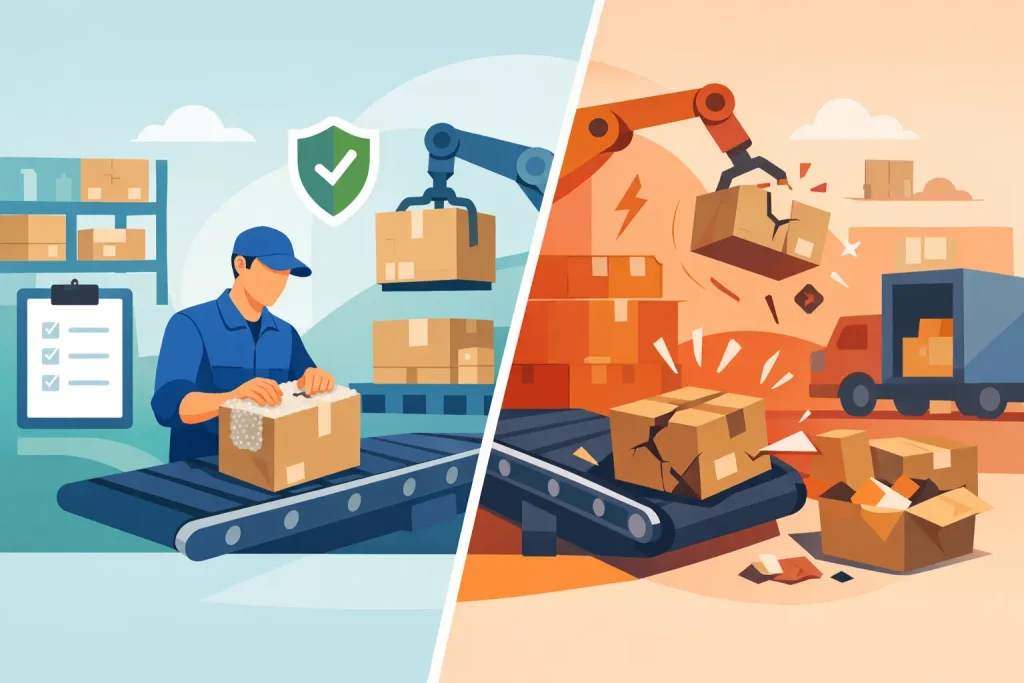
A damaged delivery is rarely caused by one careless moment. More often, it is the result of small gaps across packing, handling, storage and transport. For brands with premium or fragile stock, knowing how to prevent shipping damage means designing control points across the entire fulfilment process – not simply adding more void fill at the packing bench.
The commercial cost is larger than a replacement order. Damage creates customer service workload, return freight, lost margin and, in some cases, a customer’s lasting impression that the product is not worth its price. A quality-first logistics operation treats every parcel as a reflection of the brand inside it.
How to prevent shipping damage before an order is packed
Damage prevention starts with understanding the product, its journey and its failure points. A glass bottle, a boxed skincare set, a flat-packed homeware item and a pallet of imported cartons do not need the same protection. Packing every item to the highest possible specification can also be inefficient, increasing material cost, dimensional weight and labour time without reducing risk.
Start by assessing each SKU according to its weight, dimensions, fragility, surface finish, value and sensitivity to heat, moisture or compression. Then consider how it moves. Is it sent as a single parcel, packed with other items, dispatched in a satchel, stacked on a pallet, or transferred through multiple carrier depots? The right packaging decision depends on the most demanding part of that journey.
A practical packaging specification should identify the approved inner protection, outer carton size, void-fill requirement, sealing method and any handling labels. It should also set out what a packer must do when an item does not fit the standard configuration. This removes guesswork during peak periods, when speed matters but standards cannot move.
Product packaging also deserves scrutiny. Retail-ready packaging is not always transit-ready packaging. A beautiful presentation box may need an outer shipper, corner protection or a fitted insert before it enters a carrier network. Test the full product configuration, not just the retail unit in isolation.
Match the carton to the product
Oversized cartons are a common source of preventable damage. Empty space allows products to shift, collide and gather momentum in transit. Under-sized cartons create another problem: packers may force items into the box, placing pressure on corners, closures or product surfaces.
The aim is controlled movement, not necessarily zero movement. Use a carton that gives the product suitable clearance for cushioning material while maintaining a stable fit. Strong corrugated cartons are particularly important for heavy, fragile or high-value items, as well as shipments likely to be stacked in a carrier cage or palletised load.
Carton strength must suit the load and transport conditions. A lightweight mailer may be appropriate for soft goods, but it is not an economy choice for products that can crack, dent or be crushed. Saving a small amount on packaging can create a disproportionate cost in claims and replacements.
Void fill should support the item on all sides, not sit loosely on top. Paper, air cushions, moulded inserts, foam and corrugated dividers each have a role. The best choice depends on the item and the brand’s sustainability requirements. Paper-based protection may align well with a low-plastic packaging policy, while a fitted insert can provide better consistency for delicate products. The trade-off should be assessed against real damage data, rather than assumed.
Build disciplined packing controls
The packing bench is where the specification becomes execution. Clear work instructions, trained teams and organised materials reduce variation between orders and shifts. When stock is packed differently by every operator, the business cannot reliably identify why damage is happening.
A controlled process includes checking the item’s condition before packing, selecting the approved packaging, protecting vulnerable points, securing the carton and completing a final presentation check. For multi-item orders, packers should prevent hard items from rubbing against softer products or fragile surfaces. Separating components inside the parcel is often as important as protecting the outside.
Sealing is another detail that carries significant weight. Cartons must be closed with tape suitable for their size and load, with enough coverage to resist opening under handling pressure. Heavy cartons may require reinforced sealing or strapping, but excessive tape is not a substitute for a correctly sized and rated carton.
For premium brands, presentation belongs in the same process. An order can arrive intact yet still disappoint if it is poorly arranged, scuffed or visibly compressed. Quality checks should confirm both product protection and the unboxing standard customers expect.
Control damage across the warehouse
Parcels can be damaged before they ever reach a carrier. Poor storage practices, rushed replenishment and unstable pallets can affect stock condition long before pick and pack begins.
Keep fragile or crush-sensitive inventory in locations that minimise unnecessary handling. Avoid placing vulnerable cartons beneath heavier stock, and use racking, dividers or pallet configurations that prevent product movement. Clear location labelling helps pickers retrieve stock without dragging, squeezing or searching through mixed product lines.
Pallets require the same precision as parcels. Cartons should be stacked squarely, with weight distributed evenly and no overhang beyond the pallet edge. Overhang is exposed to impact from forklifts, pallet jacks and surrounding loads. Stretch wrap, corner boards and top protection can stabilise a load, but only when the stack itself is sound.
Inbound checks are equally valuable. If imported stock arrives with crushed cartons, wet packaging or signs of movement, record the condition before it is receipted into saleable inventory. This protects traceability and prevents pre-existing damage from being attributed to later fulfilment activity.
Choose carrier services with the product in mind
Carrier selection is a damage-prevention decision, not only a freight-cost decision. Different services have different handling profiles, delivery timeframes, sorting environments and limits around liability. A low-cost service may be suitable for durable, low-value items, while high-value or fragile products may require a more controlled service level.
Consider parcel dimensions and weight alongside the product’s vulnerability. Oddly shaped, long or heavy cartons can be harder to move through automated networks. If a shipment is particularly sensitive, a palletised or specialist freight option may provide better protection than sending individual parcels.
Handling labels such as ‘Fragile’ can support the process, but they should never be the only protection. Carrier networks are built to move volume efficiently. Packaging must withstand ordinary movement, stacking and transfer without relying on every handler seeing or acting on a label.
Set clear dispatch cut-offs and staging rules as well. Parcels left in congested collection areas are more likely to be knocked, stacked incorrectly or exposed to weather. A clean handover point, accurate manifests and scan confirmation create a more controlled transition from warehouse to carrier.
Use damage data to improve the system
The most reliable way to reduce damage is to treat each incident as operational evidence. Record the SKU, packaging configuration, carrier, service type, dispatch date, damage type and supporting images wherever possible. Over time, patterns become visible.
A spike in cracked products may point to inadequate internal protection. Repeated crushed corners may indicate carton strength, palletisation or carrier handling issues. Damage concentrated in one product line could reveal a design or supplier packaging problem rather than a fulfilment issue.
Review the data with the people responsible for packaging, warehouse operations and freight coordination. Then make a controlled change and measure the result. Changing cartons, void fill and carrier service all at once makes it difficult to know what solved the problem.
For businesses scaling quickly, this discipline is particularly valuable. What works at 20 orders a day may fail at 500, when more people, more replenishment and more carrier collections introduce variation. Durazon Logistics builds handling processes around the product, the order profile and the brand standard, giving growing businesses the operational control needed to protect stock as volume changes.
A final check that protects the customer experience
Before a parcel leaves the facility, ask one practical question: would this package still arrive in the condition promised if it were stacked, transferred and handled several times? If the answer relies on careful treatment alone, the packaging and process need strengthening.
Shipping damage cannot be eliminated in every circumstance, but it can be reduced through clear specifications, disciplined handling and a willingness to act on what the data shows. The strongest fulfilment operations make protection part of the workflow, so customers receive the product your brand intended to send.