
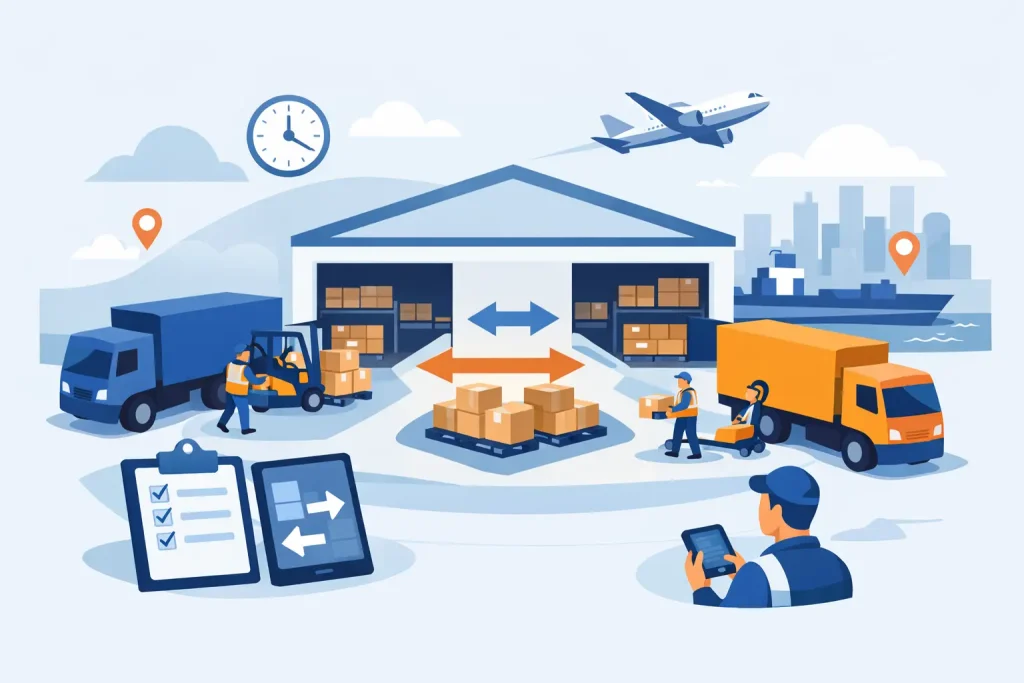
A full container lands, pallets are unloaded, sorted, checked, and turned around for outbound delivery within hours instead of sitting in storage for days. That is where cross docking services create real commercial value – not as a generic freight shortcut, but as a tightly controlled operation that reduces dwell time, compresses lead times, and keeps inventory moving with purpose.
For importers, growing brands, and operations teams under pressure to move stock quickly without compromising handling standards, cross docking can be a highly effective part of the logistics model. It is not the right answer for every product line or every supply chain. But when the conditions are right, it can improve speed, reduce unnecessary touches, and support a cleaner flow from inbound freight to final delivery.
What cross docking services actually do
Cross docking services move goods through a logistics facility with minimal storage time. Stock arrives inbound, is received and checked, then directed to outbound staging for dispatch to stores, customers, distribution points, or final-mile carriers. The facility acts as a transfer point rather than a long-term storage location.
That sounds simple on paper. In practice, it requires timing, space control, labour planning, accurate documentation, and clear visibility across inbound and outbound movements. If any one of those pieces is loose, delays build quickly. If they are managed well, cross docking becomes a disciplined way to accelerate throughput without sacrificing control.
This is why the quality of the operator matters. A premium handling model is not only relevant in warehousing. It is equally important in fast-turn environments where product is moving quickly and errors are more costly because there is less buffer time to recover.
Where cross docking services deliver the most value
Cross docking works best when speed matters, inventory is already allocated, and storage adds little value. Imported stock with pre-planned distribution is a common example. So is retail replenishment where product needs to be broken down and redirected rapidly across multiple delivery points.
For some businesses, the key benefit is reducing storage cost. For others, it is preserving delivery momentum during peak periods, avoiding congestion at the warehouse, or simplifying the transfer from container devanning to outbound distribution. Businesses with promotional stock, seasonal lines, or urgent replenishment cycles often see the strongest results because the stock has a short decision window. It needs to move, not sit.
There is also a stock integrity benefit when handled properly. Less time in storage can mean fewer touches, fewer relocations, and less exposure to avoidable handling risk. That matters for brands with presentation-sensitive products, retailer compliance requirements, or a low tolerance for dispatch errors.
The operational conditions that make it work
Cross docking is not just fast warehousing. It is a different operating rhythm.
Inbound bookings need to be accurate. Product information needs to be available before arrival. Labelling, carton counts, pallet configuration, and dispatch instructions need to align. Outbound transport needs to be coordinated around actual receiving capacity, not hopeful timing. The facility itself needs enough layout discipline to receive, sort, stage, and dispatch without creating confusion on the floor.
This is where many businesses underestimate the complexity. They assume less storage means less process. In reality, cross docking often demands more control because there is less margin for error. If inbound stock arrives late, poorly labelled, short-shipped, or mismatched against booking data, the downstream impact is immediate.
That does not mean the model is fragile. It means it must be built around precision. The strongest cross docking operations are planned with the same discipline as high-value warehousing – clear receiving rules, clean data, responsive communication, and fast exception management.
When cross docking is the wrong fit
Not every supply chain should be pushed through cross docking.
If products arrive without confirmed outbound allocation, traditional warehousing may be the better option. If demand is unpredictable, if stock needs extensive putaway and replenishment control, or if orders are being assembled over time from multiple SKUs, storing inventory in a managed warehouse environment may deliver more stability. The same applies when quality inspection, rework, relabelling, or kitting is required before dispatch.
There is also a freight reality to consider. Cross docking relies on synchronisation. If upstream suppliers, carriers, or customer delivery windows are inconsistent, forcing a cross dock model can create more pressure than value. In those cases, a blended solution often works better – holding core inventory in storage while routing selected inbound loads through cross dock lanes where timing and allocation are more predictable.
Good logistics design is rarely about choosing one model for everything. It is about matching the operating method to the stock profile, service expectations, and commercial objective.
Why visibility matters in cross docking services
Speed without visibility is risk.
When stock is moving through a facility quickly, clients still need confidence that inventory has been received correctly, exceptions have been identified, and outbound dispatch is progressing to plan. Real-time or near-real-time reporting becomes critical because there may be little physical dwell time to manually verify status after the fact.
For operations managers and founders, visibility supports decision-making. It tells you whether inbound freight is on site, whether stock has cleared receiving, whether dispatch windows are at risk, and whether any carton or pallet discrepancies need urgent action. For premium brands, it also supports accountability. You need to know that your product has been handled with care, not just moved quickly.
This is one of the clearest differences between a transactional operator and a true logistics partner. Cross docking should never feel like stock disappears into a black box and reappears somewhere else. The process needs to be responsive, trackable, and managed with ownership.
Cross docking, devanning, and distribution should work together
In many supply chains, cross docking is most effective when it is integrated with adjacent services rather than treated as a standalone task.
A container arrives. It is devan, checked, and sorted. Some stock goes directly to outbound distribution through cross dock channels. Some may move into short-term storage. Some may require co-loading or transfer into other freight networks. When these steps sit under one coordinated operating model, handover risk drops and decision-making gets faster.
That integration matters even more during peaks. Seasonal surges, retail launches, and import schedule disruptions put pressure on every point in the chain. If the logistics provider can absorb inbound variability, redirect stock quickly, and maintain clean communication across handling stages, the client gets a more stable outcome.
For businesses that need agility without losing control, that joined-up capability is often more valuable than a narrow service line offered in isolation.
What to ask before choosing a cross dock partner
If you are assessing cross docking services, the right question is not simply whether the provider can move freight through quickly. Most operators will say yes. The better question is how they control accuracy under time pressure.
Ask how inbound discrepancies are identified and escalated. Ask how stock is staged and verified before dispatch. Ask how they handle premium or fragile inventory in fast-turn environments. Ask what visibility you receive and how exceptions are communicated. Ask whether the service can flex around your demand pattern rather than forcing your operation into a rigid template.
You should also look at how cross docking sits within the wider logistics model. A provider that can align warehousing, distribution, devanning, and inventory reporting around your specific flow will usually create better outcomes than one that treats each movement as a separate transaction.
At that point, speed becomes more than a claim. It becomes controlled execution.
The real value is flow, not haste
Well-run cross docking is not about moving stock in a hurry for the sake of it. It is about removing unnecessary storage, preserving handling quality, and creating cleaner movement from arrival to dispatch. For the right product lines, that can improve service levels, reduce friction, and give your team more control over how inventory moves through the network.
That is the standard we believe matters. At Durazon Logistics, cross docking works best when it is built around your business, supported by clear visibility, and executed with clinical precision. If your stock is meant to keep moving, your logistics model should help it do exactly that.