
When a promotion goes live, a retail launch lands, or a subscription run needs to leave the warehouse on time, small handling errors become expensive very quickly. That is where kitting and assembly services earn their place – not as an add-on, but as a controlled operational function that protects accuracy, presentation and delivery performance.
For growing brands, importers and operations teams, the pressure is rarely just about moving stock. It is about getting the right products grouped, packed and presented correctly, often to a tight timeline and with little room for rework. If the kit is incomplete, labelled incorrectly or assembled without proper checks, the problem flows downstream into customer complaints, returns, retailer disputes and wasted labour.
What kitting and assembly services actually cover
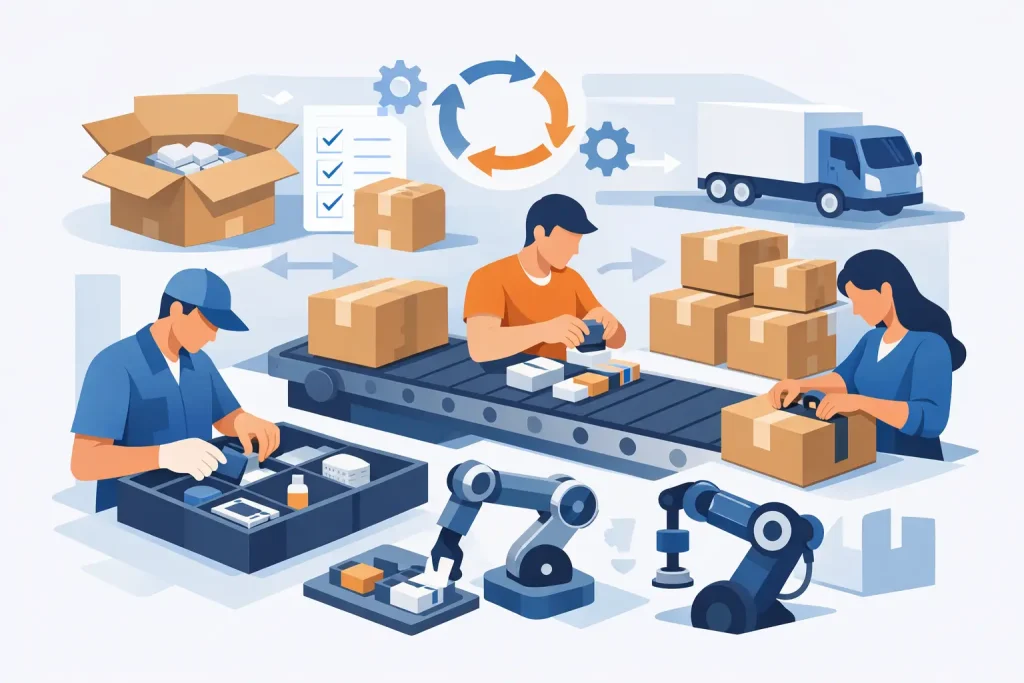
Kitting and assembly services involve bringing separate items together into a finished unit that is ready for storage, dispatch, retail distribution or final delivery. That could mean combining multiple SKUs into a promotional pack, building point-of-sale units, preparing sample boxes, applying labels, adding inserts, bundling components or completing light assembly before shipment.
The work sounds straightforward until volume, variation and timing enter the picture. One campaign may require thousands of identical kits. Another may involve several product combinations, market-specific packaging and strict handling instructions for premium stock. The difference between a tidy process and a reactive one is usually felt in labour efficiency, stock visibility and order accuracy.
For many businesses, this is the point where internal teams become stretched. Warehouse space gets used inefficiently, production tables become bottlenecks, and the same staff who should be focused on core operations end up manually building kits under pressure.
Why kitting and assembly services matter for operational control
Kitting is often treated as a packaging task. In practice, it is a stock control task, a quality task and a fulfilment task at the same time.
Each kit consumes individual inventory lines and converts them into a new saleable unit. If that movement is not tracked properly, stock records drift. If assembly instructions are not clear, variation creeps in. If quality checks are inconsistent, the finished output may technically leave the warehouse, but it does not meet brand standard.
That matters more for premium and fast-growing brands than many providers admit. A damaged carton, a missing insert or a poorly applied label can undermine the customer experience just as quickly as a late delivery. Kitting needs process discipline, not just available hands.
Well-run kitting and assembly services create tighter operational control in a few critical areas. They reduce repetitive handling, support cleaner stock movement, improve consistency across batches and make peak periods easier to manage. Just as importantly, they create a more reliable handoff between inbound stock, warehousing and outbound distribution.
Where outsourced kitting creates the most value
The best use case for outsourced kitting is not simply high volume. It is complexity combined with the need for precision.
A business launching gift packs for a seasonal campaign may need short-run agility. A wholesaler preparing retailer-ready bundles may need strict compliance and presentation consistency. An importer managing multiple product components may need assembly completed before stock can be dispatched efficiently. In each case, the value comes from having a logistics partner that can absorb the handling work without compromising inventory integrity.
This is especially relevant when demand patterns shift. Promotional activity, retail calendars and new product introductions do not always align neatly with standard warehouse workflows. Outsourced kitting gives businesses the ability to scale labour and floor capacity around those events without permanently carrying that overhead internally.
There is, however, a trade-off. Outsourcing only works well when the provider has strong process control and clear communication. If assembly instructions are vague, change requests are slow to action, or stock visibility is poor, the external model can create as much friction as it removes. The partner matters as much as the service itself.
Kitting and assembly services need more than labour
The common mistake in procurement is to compare providers on handling cost alone. That rarely tells the full story.
Reliable kitting and assembly services depend on documented workflows, batch controls, version management, QA checkpoints and accurate inventory treatment. They also depend on a team that understands that one client’s promotional pack is not interchangeable with another client’s retail unit. The handling method, packaging standard and dispatch requirement all need to be built around the product and its purpose.
That is why boutique logistics support can be a better fit than volume-first warehousing for certain brands. When product value is high, presentation matters, or campaigns are time-sensitive, close operational oversight usually delivers better outcomes than a generic assembly line approach.
At Durazon Logistics, that level of control is central to how the work is handled. The objective is not just to move units through a warehouse. It is to execute the task with clinical precision, maintain visibility at each stage, and protect the standard your customers expect.
How to assess a provider’s kitting capability
If you are reviewing kitting and assembly services, the right questions are operational, not promotional.
Start with process clarity. Ask how instructions are received, documented and approved. If a provider cannot explain how they manage revisions, substitutions or client-specific handling requirements, errors are more likely once volume builds.
Then look at inventory discipline. Good kitting changes stock status cleanly and visibly. You should know what components have been consumed, what finished kits are available and where exceptions are sitting. If that visibility is delayed or manual, planning becomes harder than it needs to be.
Quality assurance is the next test. A provider should be able to explain how they confirm count accuracy, packaging presentation, label placement and final output before dispatch. For high-value or customer-facing kits, these controls are not optional.
It is also worth asking about scalability. Some providers handle steady-state assembly well but struggle when a campaign doubles in size or a customer deadline moves forward. The best logistics partners have enough agility to flex labour and space without losing process discipline.
Common scenarios where businesses outgrow in-house kitting
In-house kitting can work when product lines are simple, volumes are stable and space is available. It becomes less efficient when those conditions change.
One common pressure point is seasonality. A business that can manage routine packing during ordinary trade may struggle when peak periods require rapid kit assembly on top of normal fulfilment. Another is SKU expansion. More combinations mean more room for picking errors, stock imbalances and confusion on the warehouse floor.
Presentation is another factor. If kits are customer-facing, retail-ready or part of a premium offer, ad hoc manual handling often shows in the finished result. Creased packaging, inconsistent inserts and uneven labelling may seem minor internally, but customers notice.
There is also the question of labour focus. When skilled internal staff are tied up building kits, they are not solving higher-value supply chain issues. For operations leaders, that opportunity cost is often the real reason to outsource.
Precision matters more when your brand is on the box
Not every kit carries the same risk. A simple two-item bundle for internal distribution is one thing. A subscription box, retail campaign unit or promotional gift set is another.
The more visible the finished product, the more kitting becomes an extension of brand delivery. Customers do not separate product quality from fulfilment quality. They judge the entire experience together.
That is why precise kitting is not just about speed. It is about handling stock carefully, assembling components correctly, and dispatching finished units in a way that reflects the standard of the business behind them. Fast assembly with weak controls is not efficient if it creates rework, returns or lost confidence.
The strongest kitting operations are built to reduce variation. They use defined methods, trained handlers and repeatable checks to keep output consistent even when timelines are tight. That consistency becomes a real commercial advantage when your brand is growing and expectations rise with it.
The right model depends on complexity, volume and risk
There is no single formula for when to outsource or how much process a kitting program needs. It depends on product mix, customer expectations, campaign timing and how costly an error would be.
For some businesses, basic bundling support during peak periods is enough. For others, kitting sits at the centre of retail readiness, promotional execution or multi-channel fulfilment. The right setup is the one that gives you control without adding unnecessary friction.
If your current process feels manual, inconsistent or difficult to scale, that is usually a sign the operation needs more structure. Well-managed kitting and assembly services do more than save time. They bring order to complexity, protect stock integrity and make it easier to deliver exactly what your customers were promised.
The practical question is not whether kitting can be outsourced. It is whether your current setup gives this part of the operation the level of care it actually requires.