
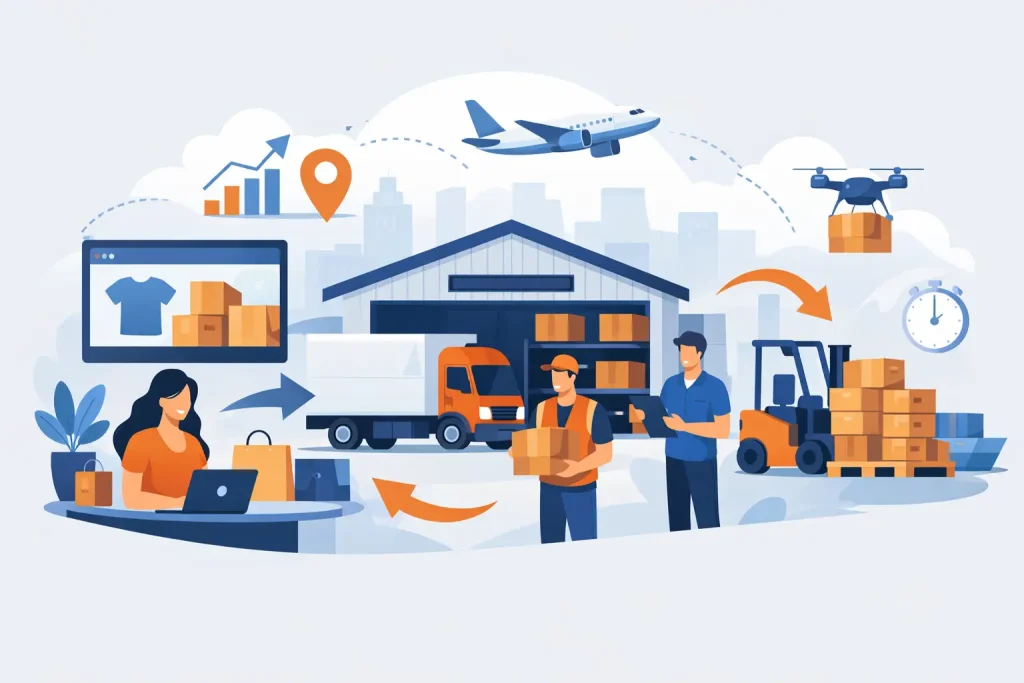
If stock is piling up, dispatch is pulling your team off higher-value work, and customers still expect fast, accurate delivery, the question becomes practical very quickly: what does a 3PL do, and where does that support actually change the day-to-day pressure on your business?
A 3PL, or third-party logistics provider, takes on some or all of the physical logistics work behind your operation. That usually includes warehousing, inventory control, pick and pack, order fulfilment, distribution, and related handling services. In a stronger model, a 3PL does more than move cartons from one point to another. It creates structure, visibility, and process discipline around the way your stock is received, stored, handled, and sent out.
For growing brands, importers, and businesses with premium inventory requirements, that distinction matters. Not every provider is built to handle stock with care, adapt to non-standard workflows, or respond quickly when priorities shift. The right 3PL becomes an operational extension of your business. The wrong one becomes another layer of friction.
What does a 3PL do in practice?
In practical terms, a 3PL takes responsibility for the logistics functions that sit between inbound stock and outbound delivery. That starts when product arrives at a warehouse. The goods are receipted, checked, recorded into inventory, and put away according to a defined storage plan. From there, the provider manages stock accuracy, monitors movement, and prepares orders for dispatch as they come through.
That sounds straightforward on paper, but execution is where value is created. A capable 3PL has to maintain inventory integrity, prevent handling damage, keep orders accurate, and move stock efficiently without losing visibility. It also needs to adjust to spikes in volume, promotional periods, retailer requirements, and changes in product mix.
For some businesses, the scope is relatively narrow. They need safe storage and reliable dispatch. For others, it is broader and more hands-on, covering kitting, labelling, rework, cross-docking, container devanning, co-loading, and coordination across multiple freight or sales channels. What a 3PL does depends partly on your operating model, but the core role is consistent: to run logistics functions with more control, consistency, and scalability than an in-house team can sustain alone.
The core services a 3PL usually handles
Warehousing is the foundation. A 3PL provides space, but more importantly, it provides managed storage. That means stock is located properly, rotated where needed, and held in conditions that protect product quality. If your goods are high-value, fragile, seasonal, or brand-sensitive, storage standards matter as much as square metres.
Inventory management sits alongside warehousing. A quality-first 3PL tracks stock movements in real time or near real time, helping you understand what is on hand, what has been allocated, and what needs replenishment. Visibility reduces costly surprises. It also supports purchasing decisions, launch planning, and customer communication.
Order fulfilment is another major function. When orders are received, the 3PL picks the correct items, packs them to specification, and dispatches them through the right delivery channel. Accuracy is critical here. A late or incorrect shipment is not just a warehouse error – it affects customer trust, retailer relationships, and internal workload.
Many providers also handle value-added services. Kitting is a common example, where multiple items are assembled into one saleable unit. Labelling, promotional bundling, returns processing, and rework can also sit within the 3PL scope. These tasks often absorb more time than businesses expect, particularly when they are managed internally without dedicated systems or floor space.
Distribution coordination is the next layer. A 3PL may arrange freight movements, manage dispatch timing, consolidate loads, or support retail deliveries. Some providers stay within warehousing and fulfilment. Others offer broader coordination across the supply chain, which can start to overlap with 4PL support.
Where a good 3PL adds real value
The obvious benefit is capacity. Outsourcing logistics gives you room to grow without leasing a larger facility, hiring a bigger warehouse team, or building your own warehouse systems. But capacity on its own is not enough. The real value comes from better process control.
A well-run 3PL brings established receiving procedures, stock controls, handling standards, and dispatch workflows. That discipline reduces mis-picks, stock loss, damaged goods, and service inconsistency. It also gives your business a more predictable operating rhythm.
Responsiveness is another major advantage. If a retailer needs urgent replenishment, a container lands earlier than planned, or a campaign causes order volume to spike, your logistics partner should be able to move quickly without compromising accuracy. That is where boutique support often outperforms larger, more commoditised models. Fast answers and hands-on ownership matter when there is stock on the line.
There is also a brand protection element that is often overlooked. If your packaging, presentation, or product condition influences how customers perceive your business, logistics is part of your customer experience. Every storage decision, every pick, and every carton that leaves the warehouse reflects on your brand.
What does a 3PL do differently from simple freight providers?
This is where some businesses get caught. Freight providers move goods between locations. A 3PL manages the operational environment around the goods.
That includes receipting stock correctly, storing it in an organised way, maintaining inventory visibility, preparing orders accurately, and handling exceptions with care. Freight is one part of the logistics chain. A 3PL sits much deeper in the workflow.
If your business only needs transport from one point to another, a freight service may be enough. If you need stock control, fulfilment, kitting, compliance handling, or day-to-day operational support, you are in 3PL territory.
The difference matters because many logistics problems are not transport problems. They are inventory problems, handling problems, communication problems, or process design problems. A proper 3PL is built to manage those issues before they reach the customer.
When outsourcing to a 3PL makes sense
A 3PL becomes especially useful when internal logistics starts distracting your team from growth. That often happens when founders are still overseeing dispatch, when warehouse space is stretched, or when inventory volumes have outgrown informal systems.
It also makes sense when your products require more care than a standard volume-based operation is likely to provide. Premium goods, fragile items, retailer-specific pack requirements, and custom kit builds all benefit from a more controlled handling model.
Seasonality is another trigger. If your business has demand peaks that would leave an in-house warehouse underused for half the year and overloaded for the other half, outsourced logistics can give you a more flexible cost and staffing structure.
That said, outsourcing is not automatic. If your operation is highly specialised, deeply integrated into production, or dependent on constant last-minute changes without clear process rules, the transition needs careful planning. A 3PL works best when there is alignment on systems, service expectations, handling standards, and accountability.
How to assess whether a 3PL is the right fit
Not all 3PLs are built the same. Some are geared for scale and standardisation. Others are designed for responsiveness, tailored workflows, and close operational support. The right fit depends on your priorities.
If stock accuracy, careful handling, and direct communication are central to your business, those should not be treated as optional extras. Ask how inventory is managed, how discrepancies are handled, what visibility you will have, and who is accountable when issues arise. A provider should be able to explain its process clearly, not rely on vague promises.
It is also worth assessing how they deal with non-standard requirements. Can they support kitting? Can they manage retail-ready preparation? Can they adjust quickly if your inbound schedule changes or a customer order becomes urgent? Logistics performance is tested in the exceptions, not only in routine dispatch.
A strong 3PL relationship should feel structured, transparent, and commercially aligned. It should reduce operational noise, not add another layer of chasing, rechecking, and avoidable follow-up.
For businesses that need logistics done properly, the answer to what does a 3PL do is simple: it protects the flow of stock, the quality of fulfilment, and the reliability your customers expect. When that support is built around your business rather than forced into a generic model, logistics stops being a constraint and starts becoming a stronger part of how you grow.