
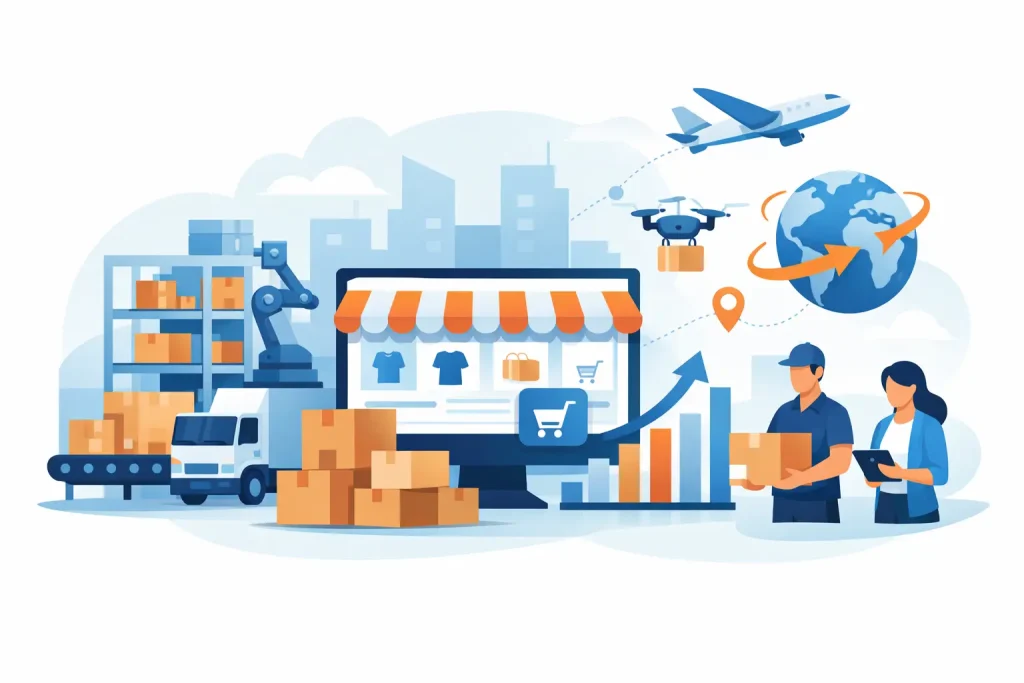
Growth usually shows up in operations before it shows up anywhere else. Order volumes jump without much warning, SKUs multiply, promotional peaks hit harder than forecast, and suddenly the process that worked six months ago starts creating delays, stock errors and customer complaints. Scalable fulfilment for growing brands is about building logistics capacity that can absorb that pressure without letting service standards slip.
For founders, operations managers and supply chain leaders, that challenge is rarely about space alone. It is about whether your fulfilment model can keep pace with the way your business is changing. More channels, more products, more retail and wholesale complexity, and tighter delivery expectations all demand a more disciplined operating structure. If fulfilment is treated as a basic back-end function, growth becomes expensive very quickly.
What scalable fulfilment for growing brands actually means
Scalable fulfilment is not just bigger warehousing. It is a fulfilment operation that can expand in volume, complexity and speed while maintaining accuracy, inventory control and brand consistency. That means your warehousing, pick and pack, kitting, dispatch workflows and reporting all need to be built for change, not just for current demand.
A growing brand often feels the strain in stages. At first, the issue is capacity. Then it becomes visibility. After that, the real problem is control. Stock may be in the building, but not in the right location. Orders may be moving, but not with the consistency your customers expect. Teams end up spending too much time correcting preventable issues instead of planning ahead.
A scalable model deals with those pressure points early. It uses structured receiving, disciplined putaway, accurate inventory handling and clear dispatch rules so increased volume does not automatically create increased friction. That sounds straightforward, but many brands only discover the value of that discipline once growth starts exposing weaknesses.
Why fast growth breaks basic fulfilment setups
The first version of a fulfilment operation is often practical rather than strategic. A brand starts with available space, a small team and a process that gets orders out the door. That works until order profiles become less predictable.
The pressure usually comes from several directions at once. Product ranges expand. Retail replenishment and direct-to-consumer orders need different handling. Promotional campaigns create short-term spikes. Imported stock lands in larger volumes and has to be turned around quickly. If there is no clear operational framework behind the activity, every increase in demand adds another layer of risk.
Accuracy is often the first casualty. Mis-picks rise when warehouse layouts no longer match stock velocity. Dispatch delays appear when order batching has not been designed for scale. Inventory integrity suffers when receiving and storage rules are inconsistent. These are not minor warehouse issues. They affect customer trust, retail relationships and margin.
For premium brands, the stakes are even higher. If your products require careful handling, presentation standards or customised kitting, fulfilment cannot be treated as a commodity service. The operation needs to protect the brand as much as it moves the stock.
The operational foundations that make fulfilment scalable
A scalable fulfilment model starts with inventory control. If inventory data is not reliable, every downstream process becomes reactive. Real-time visibility matters because growing brands need to make purchasing, production and distribution decisions with confidence. When visibility is delayed or fragmented, teams compensate manually, and manual work rarely scales well.
The second foundation is process discipline. Receiving, devanning, putaway, replenishment, pick and pack, kitting and dispatch all need clear workflows. Not complicated workflows. Clear ones. The best operations are often the most controlled, because each stage has defined checks and accountabilities.
The third foundation is flexible capacity. This is where many providers overpromise. True flexibility does not mean saying yes to every volume increase and hoping the floor can absorb it. It means having labour planning, space allocation and workflow design that can adapt to seasonal peaks, launches and channel shifts without creating service drift.
Then there is communication. Growing brands need more than a warehouse that processes orders. They need a logistics partner that surfaces issues early, responds quickly and gives practical visibility into what is happening on the floor. Silence in logistics is rarely a sign that everything is fine.
Where outsourced fulfilment starts to make sense
There is no single revenue point where outsourcing becomes the right move. It depends on order complexity, stock profile, internal capability and how much management time is being consumed by fulfilment. Some brands outgrow their internal setup because they physically run out of room. Others still have space, but their process can no longer support the operational standard the business requires.
A useful test is this: is your team spending more time managing warehouse friction than driving growth? If the answer is yes, fulfilment is no longer just an internal function. It is a strategic constraint.
Outsourcing can remove that constraint, but only if the provider is set up to operate as an extension of your business. For growing brands, generic high-volume handling is often the wrong fit. What matters is whether the provider can align to your order profile, stock requirements, service expectations and reporting needs.
That is especially relevant when your inventory is high value, fragile, time-sensitive or tied closely to brand presentation. In those cases, careful handling and process accuracy are not extras. They are core service requirements.
How to assess scalable fulfilment for growing brands
When evaluating a fulfilment partner, brands often focus on storage rates and dispatch pricing first. Cost matters, but it should not be the only lens. Cheap fulfilment becomes expensive when it creates stock loss, shipment errors, delayed replenishment or avoidable customer service load.
A better assessment starts with operational fit. Can the provider manage your current order mix and the next version of it? Can they support kitting if product bundles become more common? Can they handle cross-docking or devanning if inbound volumes increase? Can they maintain inventory accuracy as SKU counts grow? These are scaling questions, not just service questions.
Visibility should also be tested properly. Ask how stock is tracked, how exceptions are flagged and how quickly information is updated. If inventory reporting is vague, growth planning becomes guesswork.
Responsiveness matters just as much as system capability. A strong fulfilment model includes disciplined processes, but it also needs people who take ownership. Delays, discrepancies and urgent requests happen in every supply chain. What separates a capable logistics partner is the speed and quality of response when they do.
Precision matters more as complexity increases
As brands grow, complexity usually outpaces volume. That is why fulfilment needs clinical precision, not just more hands on the floor. Ten extra orders a day may not change much. Ten extra SKUs, two new sales channels and a retail rollout absolutely will.
This is where tailored logistics infrastructure becomes valuable. A business with recurring wholesale dispatches, promotional bundles and imported container stock does not need the same warehouse setup as a simple e-commerce operation. The process design should reflect the shape of the business.
At Durazon Logistics, that principle sits at the centre of how scalable support should work. The goal is not to force brands into a fixed warehouse model. It is to build logistics execution around the way the business actually operates, with quality-first handling, clear visibility and the capacity to scale without losing control.
That level of support is particularly important during transition points. New product launches, major retail onboarding, seasonal demand shifts and rapid sales growth all place pressure on fulfilment. If the operating model is already stretched, those moments expose every weakness.
Growth is easier when fulfilment stops being a risk factor
Strong fulfilment should create confidence. Your team should know stock is being handled carefully, orders are being picked accurately and capacity is available when demand moves. That confidence changes the way a business operates. Purchasing gets sharper. Sales planning becomes more realistic. Customer service spends less time fixing preventable problems.
Not every brand needs the same level of logistics support, and not every stage of growth requires the same solution. But if fulfilment is starting to absorb management attention, create service inconsistency or limit your ability to scale, the answer is usually not to keep patching the process. It is to put a more capable structure underneath the business.
The right fulfilment model should feel controlled, visible and built around your standards. When that foundation is in place, growth becomes something to support properly, not something to brace for.