
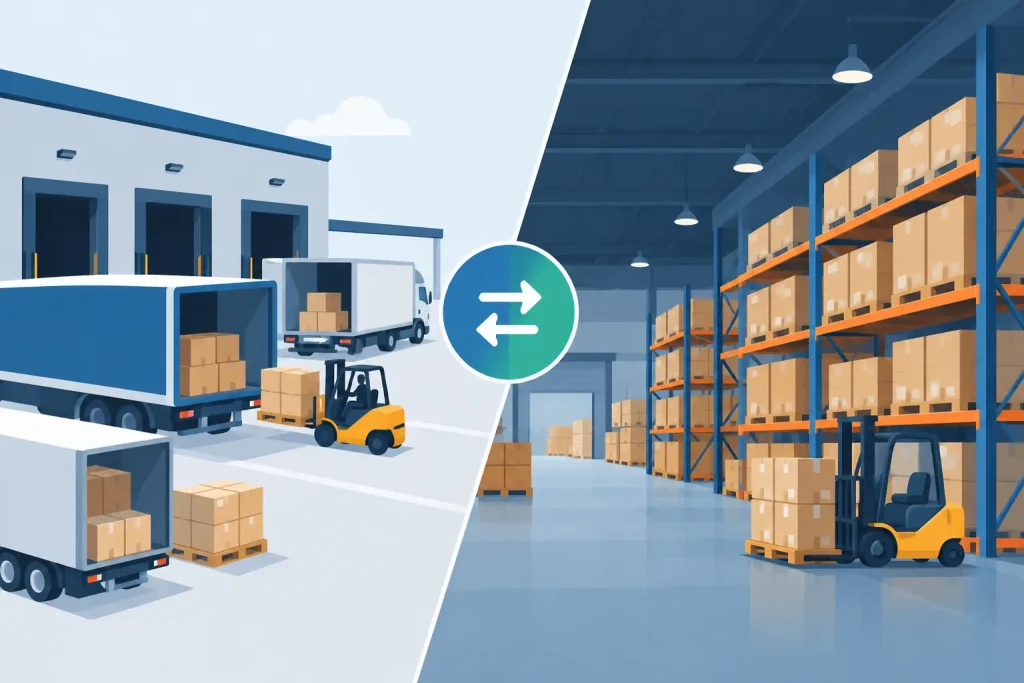
A container arrives, retail orders are waiting, and your customers expect stock to move without delay. The decision between cross docking vs warehousing determines far more than where cartons sit. It shapes inventory visibility, delivery speed, handling risk, working capital and the level of control your team retains when demand changes.
For growing brands and importers, neither model is automatically better. The right choice depends on product characteristics, order patterns, supplier reliability and the service promise made to your customers. A quality-first logistics operation starts by matching the process to the stock, rather than forcing every product through the same network.
Cross Docking vs Warehousing: The Core Difference
Cross docking is a transfer model. Goods are received, checked, sorted and moved directly to outbound transport with little or no storage time. A shipment may arrive from a supplier in the morning and be allocated to stores, distributors or customer orders that same day. The warehouse functions as a controlled transfer point rather than a long-term storage location.
Warehousing is a stockholding model. Inventory is received, counted, put away and managed in storage until it is required for fulfilment, replenishment or distribution. Orders are then picked, packed and dispatched against demand. It gives a business a physical buffer between supply timing and customer demand.
The distinction is simple, but execution is not. Cross docking requires accurate inbound information, firm outbound plans and disciplined timing across every party involved. Warehousing requires location control, stock accuracy, careful handling and a reliable fulfilment process. Both depend on operational precision. They simply apply it at different points in the supply chain.
When Cross Docking Creates an Advantage
Cross docking can be highly effective when product already has a destination before it arrives. Think of imported cartons allocated to retail stores, promotional stock required for a defined campaign, or fast-moving replenishment inventory that needs to reach distribution points quickly.
Its most immediate advantage is speed. Less dwell time can mean faster delivery to stores or downstream customers, which is valuable when shelf availability matters or a launch date cannot move. It can also reduce storage costs, as stock is not occupying pallet positions for extended periods.
The model may reduce handling too. Fewer touches can lower the chance of carton damage, misplacement or unnecessary repacking, provided the inbound load is correctly labelled and the transfer process is tightly controlled. For premium products, reducing avoidable movement is a sensible protection measure.
Cross docking can also support a leaner inventory position. If suppliers, freight providers and recipients are aligned, businesses can avoid holding more stock than they need simply to protect against poor coordination. That said, cross docking does not remove inventory risk. It moves the risk upstream, where inaccurate forecasts, late containers or incomplete paperwork can quickly disrupt the outbound plan.
This approach suits predictable, high-volume flows best. It is less forgiving when orders are fragmented, destination allocations change at short notice, or suppliers deliver mixed and poorly prepared freight. A cross-dock operation must have receiving windows, booking discipline, clear carton-level identification and confirmed transport capacity. Without those controls, a fast transfer point becomes a congested holding area.
When Warehousing Is the Better Commercial Decision
Warehousing gives businesses time, flexibility and control. It is usually the stronger option when demand is variable, products need individual order fulfilment, or inbound supply does not arrive in a pattern that matches customer orders.
For many boutique brands, stock is not simply moved from one truck to another. It may need quality checks, labelling, kitting, product assembly, pick and pack, or tailored distribution by sales channel. Warehousing provides the infrastructure to complete those tasks without compromising accuracy or presentation.
Holding inventory also protects service levels when supply and demand operate on different clocks. A brand may import stock monthly but fulfil online orders daily. A retailer may require replenishment in small, frequent quantities even though the supplier delivers in pallet loads. Warehousing absorbs that mismatch and gives operations teams room to respond.
There is a cost to this flexibility. Storage, receipting, inventory management and fulfilment all need to be accounted for. Yet viewing warehousing only as a cost line misses its commercial role. Well-managed stock can prevent lost sales, avoid rushed freight, support seasonal peaks and protect the customer experience when supply is uncertain.
The standard of warehouse management matters particularly for high-value, fragile or brand-sensitive inventory. Accurate receiving, controlled locations, real-time visibility and careful handling are not administrative extras. They are how a business knows what it can sell, where its stock is and whether every order leaves in the condition customers expect.
The Trade-Offs That Matter Most
The practical decision is rarely a straight choice between speed and storage. It is a question of where your business needs certainty.
Cross docking is strongest when inbound and outbound activity can be planned with confidence. It favours pre-allocated stock, stable volumes and transport networks that meet agreed delivery windows. Warehousing is strongest when you need a buffer against uncertainty, the ability to fulfil diverse order profiles, or a controlled environment for value-added services.
Cost should be assessed across the full operation, not just by comparing a pallet storage rate against a cross-dock handling fee. A lower storage bill may be offset by urgent transport, missed retailer delivery slots, rework or lost revenue when stock is not available at the right time. Equally, holding excessive inventory can tie up cash and create unnecessary handling exposure.
Inventory visibility is another deciding factor. Cross docking needs visibility before freight arrives: what is coming, how it is packed, where each carton is going and when outbound vehicles will depart. Warehousing needs visibility throughout the stock lifecycle: receipt, putaway, allocation, picking, returns and replenishment. In either model, delayed or unreliable data creates operational risk.
Product profile also matters. Shelf-stable, high-turnover products with clear allocations are natural cross-dock candidates. Products with multiple SKUs, complex order configurations, seasonal demand or strict presentation requirements generally benefit from warehousing. Temperature-sensitive, regulated or delicate goods may require specialised controls regardless of how quickly they move.
A Hybrid Model Often Delivers the Best Result
Many businesses do not need to choose one model for every shipment. A hybrid approach can combine the pace of cross docking with the control of warehousing.
For example, a large inbound shipment may be received and quality-checked before one portion is cross docked to retail locations with confirmed purchase orders. The remaining stock can be stored for e-commerce fulfilment, wholesale replenishment or future campaign activity. This keeps priority stock moving while preserving availability for less predictable channels.
The same approach works well during seasonal peaks. Pre-allocated promotional stock can move straight through the facility, while core products remain in managed storage to support daily demand. It can also be useful for businesses transitioning from ad hoc freight coordination to a more mature fulfilment operation, as it creates room to test demand patterns without overcommitting to a single model.
A capable logistics partner should be able to manage both workflows without losing chain of custody. That means clear inbound booking, clinical receiving checks, accurate stock allocation, disciplined staging and fast communication when an exception appears. The objective is not merely to move cartons. It is to protect the service level your brand has promised.
Questions to Ask Before You Decide
Start with your demand pattern. If most stock is already allocated to known destinations when it lands, cross docking may improve speed and reduce unnecessary storage. If orders arrive continuously, vary by channel or require individual fulfilment, warehousing will usually provide stronger service control.
Then examine the reliability of the information flowing into your operation. Can suppliers provide accurate advance shipment details? Are carton labels, product codes and quantities consistent? Are recipients ready to accept delivery when stock arrives? Cross docking depends on confident answers to each question.
Finally, consider the cost of failure. A delayed transfer might be manageable for commodity replenishment but unacceptable for a product launch, a major retailer commitment or premium customer orders. Where the cost of an error is high, invest in the process controls and handling standards that keep stock visible, protected and accountable.
The best logistics model is the one built around your actual flow of goods, not the one that looks cheapest on a spreadsheet. Whether stock needs rapid transfer, carefully managed storage or a combination of both, the right operating design gives your team confidence that every carton is being handled with the same care as your brand itself.