
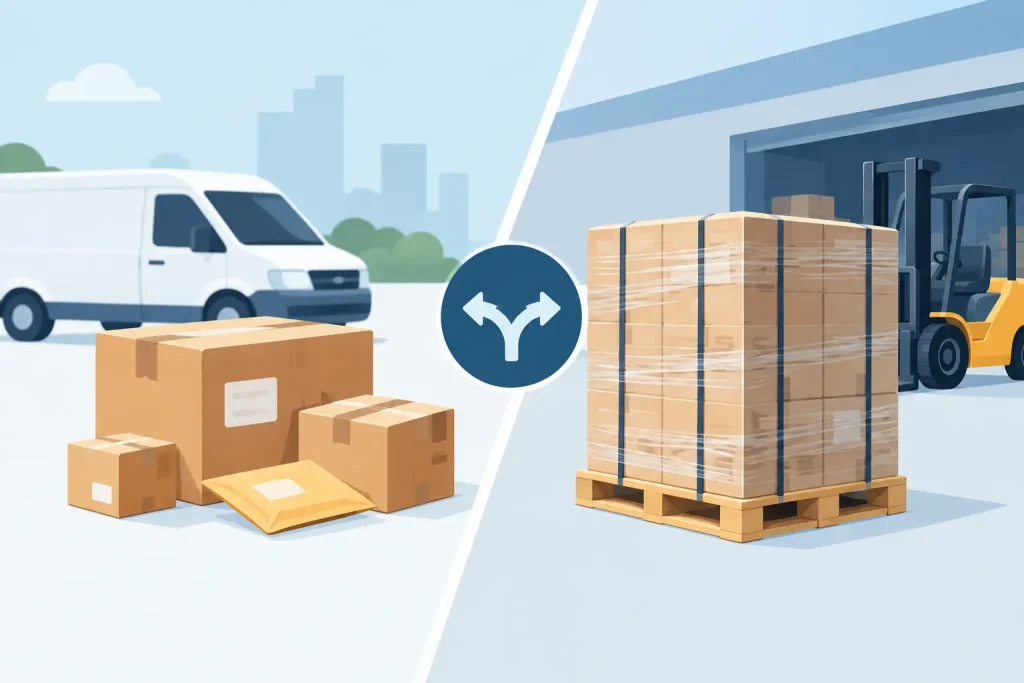
A carton sent as a parcel and the same carton shipped on a pallet can produce very different costs, delivery outcomes and handling risks. The parcel versus pallet freight decision is not simply about weight. It is about how your stock moves through the network, how often it is touched, and what level of control your brand requires at every handover.
For growing brands, the wrong freight mode can erode margin, create avoidable damage, and leave customers waiting for products that were available all along. The right model protects inventory, supports service expectations and gives your operation room to scale without losing discipline.
Parcel versus pallet freight: the operational difference
Parcel freight is designed for individual cartons, satchels and smaller consignments moving through high-volume carrier networks. It is generally suited to direct-to-consumer orders, samples, replacement stock and low-volume business deliveries. Parcels are scanned frequently and travel through sorting facilities built for speed and volume.
Pallet freight, often referred to as less-than-truckload freight, moves multiple cartons or bulk goods secured to a pallet. It is commonly used for wholesale replenishment, retail distribution, warehouse transfers and larger business-to-business orders. The pallet becomes the handling unit, allowing the freight to be moved by forklift or pallet jack rather than manually carton by carton.
That difference matters. A parcel may pass through automated belts, cages, depots and delivery vehicles alongside hundreds of other items. A pallet is typically consolidated, wrapped, labelled and handled as one unit. Neither option is automatically better. Each suits a different order profile and risk level.
When parcel freight is the stronger choice
Parcel freight performs well when orders are small, dispersed and time-sensitive. If your business sends individual orders to customers across Australia, a parcel network is often the most practical way to reach residential and commercial addresses without building a complex delivery operation.
It also gives customers familiar tracking events and flexible final-mile options. For ecommerce brands, those communications can be part of the customer experience. A clean dispatch process, accurate address data and appropriately sized packaging are essential because parcel carriers price heavily around dimensions as well as actual weight.
Parcel freight is usually a good fit when an order is light enough to be safely handled by one person, consists of a limited number of cartons, and does not require a forklift at either end. It can also be effective for urgent replenishment, provided the cost is proportionate to the value of the stock and the commercial urgency.
The trade-off is handling intensity. Individual parcels are exposed to more touchpoints, more sorting and more opportunities for labels to be damaged, cartons to be crushed or items to be misrouted. Premium, fragile or irregularly shaped products need packaging engineered for the journey rather than simply packed to look good when it leaves the warehouse.
When pallet freight delivers better value
Pallet freight becomes compelling when several cartons are travelling to the same destination, particularly a retailer, distributor, warehouse or job site. Consolidating stock onto a pallet can reduce the per-carton freight cost and gives the consignment a more controlled handling profile.
For example, sending 20 cartons individually to a retail distribution centre may create 20 labels, 20 scan histories and 20 chances for a delivery exception. Sending those cartons as a correctly built pallet creates one freight unit with clearer accountability. It is often easier to receive, count and move once it arrives.
Palletisation is particularly valuable where stock has a higher replacement value or requires careful presentation. Cartons can be configured for stability, protected with corner boards where appropriate, wrapped securely and clearly labelled on multiple sides. This reduces movement in transit and helps receiving teams identify the shipment quickly.
However, pallet freight requires more planning. The destination must be able to receive palletised goods, and access constraints matter. A boutique retailer in a tight inner-city location may not have a loading dock, forklift or safe area for a large vehicle. Booking requirements, tail-lift needs, delivery windows and site rules must be confirmed before dispatch.
Cost is more than the freight quote
A low line-haul price does not always produce the lowest landed cost. Freight decisions should account for packing labour, packaging materials, storage space, claims exposure, delivery failures and the cost of stock being unavailable at the point of sale.
Parcel pricing can rise sharply when cartons are bulky, even if they are light. Freight providers use cubic weight to reflect the space a consignment occupies in their network. A large box of lightweight product can therefore cost far more than its physical weight suggests.
Pallet freight may appear more expensive at first glance because it includes pallet hire or purchase, wrapping, preparation and specialised collection. Yet when volume increases, those costs can be offset by lower handling per carton and reduced risk of consignments being separated in transit.
The most useful comparison is not parcel rate versus pallet rate. Compare the total cost per delivered unit, alongside the expected service level and the consequence of an exception. A high-value retail order delayed by two days can cost more than the difference between two freight options.
Build the freight decision around the order, not habit
Many businesses default to the method they used when order volumes were smaller. That can lead to oversized parcel consignments, inefficient split shipments or pallets sent to locations that cannot receive them. A better approach is to set clear decision rules based on your stock and customers.
Start with the destination. Residential addresses and small commercial premises generally favour parcels. Retail distribution centres, warehouses and trade customers with receiving infrastructure are more likely to suit pallets.
Then assess the consignment itself. Consider carton count, cubic volume, total weight, product fragility, stackability and whether cartons must remain upright. A single awkward carton may still need specialist handling, while six compact cartons might be more efficiently secured to one pallet.
Finally, consider delivery urgency and customer promise. Parcel networks can be efficient for broad residential coverage, while pallet services may be more suitable for planned commercial replenishment. The best choice depends on the specific lane, carrier capability and required arrival window, not a blanket rule.
Packaging and labelling protect the freight plan
Whether stock moves as parcels or pallets, preparation determines whether the chosen freight method performs as intended. Cartons should be right-sized, sealed correctly and strong enough for the expected stacking pressure. Void fill should prevent movement without adding unnecessary cubic volume.
For pallets, load configuration is critical. Heavy cartons belong at the base, the footprint should remain within pallet edges, and the stack should be stable before wrap is applied. Overhang increases the likelihood of impact damage. A pallet that appears secure in the warehouse can still fail after vibration, braking and repeated handling if the load has not been built with discipline.
Labels should be legible, consistent with booking data and placed where they remain visible after wrapping. For multi-carton shipments, carton numbering such as 1 of 6 and 2 of 6 supports better receiving control. Where retailers require purchase order numbers, carton labels or booking references, these details should be verified before freight is collected.
Visibility and exception management matter most
Tracking is useful, but it is not the same as operational control. A tracking event tells you a shipment has been scanned. It does not necessarily tell you whether a delivery booking is valid, whether the freight has been received in full, or whether a damaged carton has been identified before it reaches your customer.
Quality-first distribution requires active exception management. That means monitoring consignments that miss expected milestones, checking delivery constraints before dispatch, and escalating issues while there is still time to protect the customer outcome. For high-priority stock, the value sits in the response, not merely the tracking link.
This is where an integrated warehousing and distribution partner can make a material difference. When inventory, pick and pack, pallet build, carrier booking and dispatch checks are managed through one accountable operation, there are fewer handovers and clearer ownership. Durazon Logistics approaches distribution as an extension of the client’s business, with the handling discipline required to protect stock integrity from storage through to dispatch.
Create a freight matrix before volumes force the issue
A simple freight matrix gives your team a repeatable basis for choosing between parcel and pallet services. It should define practical thresholds for carton count, cubic volume, weight, product value, destination type and urgency. It should also identify exceptions, such as fragile products, retailer delivery bookings or sites requiring tail-lift access.
Review the matrix regularly. Carrier performance changes, customer order patterns shift, and a product that once moved comfortably by parcel may become a pallet candidate as wholesale volumes grow. Decisions should be informed by actual dispatch data, delivery performance and claims trends rather than assumptions.
The aim is not to force every order into the cheapest channel. It is to select the freight method that protects your service promise at a sensible total cost. When each consignment is matched to the way it needs to move, distribution becomes quieter, more predictable and far easier to scale.